spoon2017-04-22-

Find 37: Relic or Replica?

In my last entry, we looked at how early modern metalworkers used clever “modular” casting tricks to customise their wares, drawing a comparison to the famous Apostle spoons of the Tudor and Stuart eras. Reading back over those paragraphs, I realised I hadn’t yet documented one of my earliest and absolute favourite local finds—an actual Apostle spoon! It is a beautiful piece of tableware with a fascinating story to tell, but it hides a cheeky little manufacturing secret that perfectly highlights the line between an ancient relic and a clever Victorian replica.

I found this item way back in 2017, practically my first year out detecting. At the time, I had just the one permission in West Grimstead and absolutely no idea how historically rich a location it would turn out to be. Equipped with a modest, mid-range detector, I slogged my way up to the very top of a sloped pasture. The climb winded me a bit, as I hadn’t yet learned the golden rule of going “low and slow.”

About halfway back down the incline, my machine let out a crazy loud signal. Even though my stomach was rumbling and I was purposefully heading home for lunch, the sheer urgency of the signal stopped me in my tracks. I just had to dig it up. When I peeled back the turf, I pulled out something completely beyond my experience at the time: a delicate little spoon with a tiny, beautifully detailed religious figure perched right on the top. I was absolutely hooked.
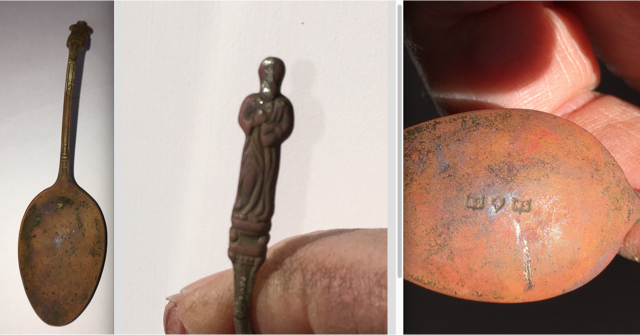
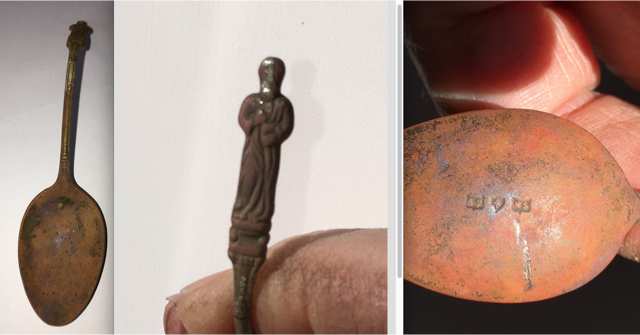
This Electroplated Nickel Silver (EPNS) spoon represents St. James the Greater, and over the decades, its time in the Wiltshire soil has given it a rich, warm, copper-coloured patina. Despite its long sleep, the tiny cast figurine at the top of the handle—known as the “finial”—has survived with remarkable detail. The figure is crowned with a flat, circular halo (historically known as a nimbus) and wears flowing garments. Running down the left side of his robe is a distinct, raised vertical line. In traditional spoon-making, fragile elements like walking sticks were cast flat against the body so they wouldn’t snap off. This is a pilgrim’s staff, identifying him as St. James, the patron saint of pilgrims.

At first glance, finding a spoon depicting a medieval saint near ancient parish paths feels like a ticket straight back to the 16th century! But when I cleaned off the dirt inside the bowl, the maker’s marks told a very different story: EP [♥] NS.

To my untrained eye, these looked like classic 17th-century silver hallmarks. However, this is actually a Victorian pseudo-hallmark. During the late 19th-century Gothic Revival, manufacturers stamped replicas with deceptive marks that were actually clever abbreviations for modern materials: EP for Electroplated, and NS for Nickel Silver.

Because these ornate spoons were traditionally given as christening gifts to be kept as treasured keepsakes, they carried a deep sentimental value. It is incredibly easy to picture a bright Saturday afternoon in the late 1890s, with a local family gathered in the village pasture to celebrate a birth. In the bustling excitement of the outdoor gathering, the prized gift slips off a table and into the deep grass, lost to time until my detector crossed its path 130 years later. It sits proudly on my display shelf today as a fantastic piece of social history—a bridge between the deep medieval past of our parish and the vibrant, close-knit community that shaped West Grimstead at the turn of the century. As my detecting career proceeded, I would soon find that indeed, every find tells a story!
 
WILT-DB17D8_689df79341fa2

Find No. 36: A Mouldy Mystery

The weeks-long heatwave barely gave us a break, but it did pause to take a humid breath, so of course I was out in the afternoon glare trying to get in a few minutes detecting before the promise of shade and supper called me back home. Just when I thought trudging across the baked soil, on a hillside no less, was not the best way to spend my day, I found something that left me standing in the middle of a hot pasture scratching my head in absolute bewilderment.

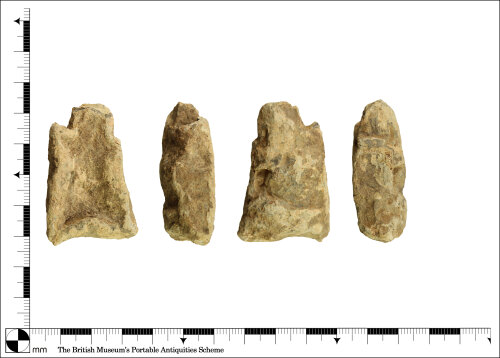
I was not far from some forgotten Augustinian ruins when the machine let out an absolute screamer of a signal. It took some effort to punch my spade through the bone-dry soil, but when I flipped the plug up I could see a dense chunk of cast lead with a dull, rugged whitish-grey patina. I nearly threw it straight into my recycling pile, as I’d promised the landowner I’d take away any scrap metal. But when I hosed it off later for a closer look, I noticed a crude raised rim with a hollow, recessed shape. I was holding a fragment of a post-medieval lead casting mould (officially logged as WILT-DB17D8), weighing 116.3 grams and measuring just over 4.6 cm.

Even our museum experts found it a head-scratcher. The inside face depicts what strongly appears to be a robed human figure with raised, stumpy arms, while the reverse suggests it was part of a two-piece press mould clamped together. Because lead has a low melting point, you cannot pour liquid lead into it without the two fusing. Instead, this block was likely a master reusable mould—a single, clever step in a highly skilled artisan’s lost-wax casting process.

The mould was designed to produce a “blank canvas” body out of warm, soft beeswax. Once the generic robed body was pressed out, the workshop could customise it with ease, much like the famous Apostle spoons of the era. By pinning on separate, hand-carved wooden elements—like praying hands, wings, or a tiny head—before the final multi-stage moulding process, the craftsmen could turn the exact same wax body into a serene angel, a tonsured monk, or a unique saint.

It’s amazing to think that someone sat by a fire or kiln somewhere not far from Clarendon Palace, using this very cavity to press out figure after figure. Was it dropped while working from a temporary roadside marketplace pitch, or simply discarded when the end snapped off, making it too difficult to align properly?

Returned to me by the Finds Liaison Officer, this piece of cottage-industry history now sits safely on my display shelf. It inspires many possibilities as I try to fathom its history, proving that indeed, every find tells a story!
wholekegkey

Find no. 38: A Final Gift from a Grimstead Field

There is a particular clarity to the Wiltshire landscape in mid-October. The air this morning carried that crisp, clean bite that signals the true turning of the season. I was walking a sloping pasture just adjacent to the historic Norman chapel here in West Grimstead, and the ground beneath my boots felt firm, the grass slick with a heavy autumn dew. It is a quiet time of year; the frantic energy of the harvest has passed, the fields are shorn and resting, and the rooks are wheeling in great, lazy circles against a pale blue sky. Up here, away from the busy hum of Grimstead Road, you are enveloped by a profound stillness. It is just you, the steady rhythm of your breath, and the gentle, reassuring chirp of the detector.

There is a wonderful patience required on days like this. You aren’t rushing; you are sweeping the coil in slow, deliberate arcs, almost like scything hay. It’s a meditative process that forces you to slow your mind to match the pace of the landscape. I had been out for nearly two hours, enjoying the solitude more than anything, when I received a beautifully crisp, repeatable signal on a gentle slope just a stone’s throw downhill from the ancient chapel walls.

Kneeling down in the damp earth, I peeled back a neat sod of turf. The entire field had been full of modern scrap, so I was given to a moment of anticipation when this solid signal came to me, then the soil parted. And from there–not so deep as to be a chore–came that glinting, familiar, soft dull-green patina of aged copper alloy. I now held a curious, conical object!

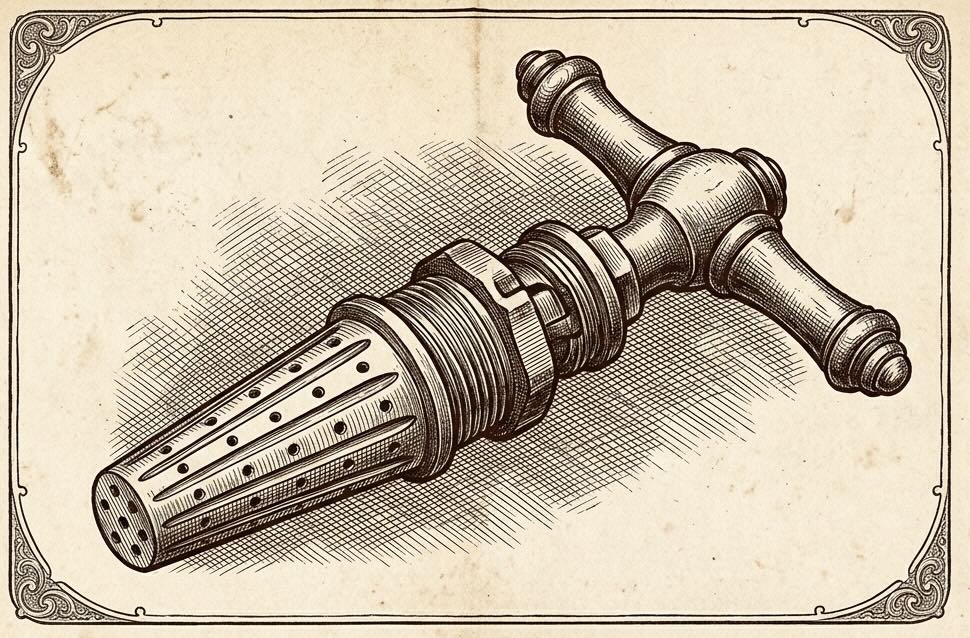
Upon initial inspection, it looked for all the world like a standard post-medieval keg key or plug—the sort of utilitarian object used to tap beer or cider barrels in local taverns across the county. I’ve encountered pieces of rural hospitality before, but as I brushed away the clinging Wiltshire soil, this thirty-sixth find of our collection began to tell a story uniquely tied to the very spot where it fell.

The Find & Its Story

  • Unique ID: WILT-04CAF4
  • Object Type: Keg plug / tap fragment
  • Broad Period: Post-Medieval to Modern (c. AD 1800–1900)
  • Material: Cast copper alloy
  • Weight: 19.0g
  • Dimensions: 44.8mm in length; 17.1mm diameter at its thickest point.

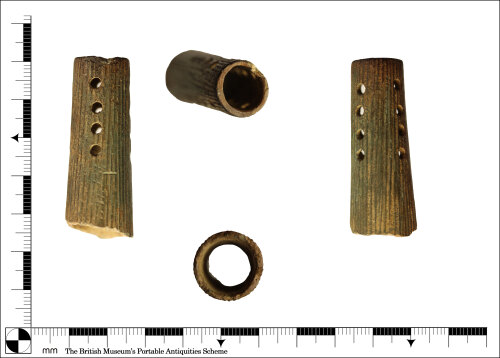
At its core, the object is a hollow, cast copper-alloy conical plug. The wider end is broken, indicating it was snapped away from a larger mechanism—specifically, the main body of a heavy brass or copper barrel tap. The exterior is decorated with rather elegant, shallow incised fluted lines.

This is the business end of a working barrel tap. When a heavy wooden keg of cider or ale was brought out for a grand community occasion, the tap had to be driven home into the barrel’s bung with a heavy wooden mallet. Those 16 drilled holes weren’t meant for a garden hose; they were the internal sieve of the tap itself, designed to sit inside the liquid and strain out the yeast, sediment, and likely wood chips as the beverage was poured, ensuring a clean pint for the thirsty villager.

Given that it was discovered just outside the Norman churchyard boundary in West Grimstead, on a perfectly sheltered, slightly downhill slope, a wonderfully clear picture emerges. This wasn’t lost during solitary farm work. This tap likely met its end during a Victorian or Edwardian village fete, a church bazaar, or a beating-the-bounds celebration.

We often tend to view history through the lens of grand, solemn events, particularly when searching near religious architecture that has stood since the Normans. But churches and chapels were not just places of Sunday worship; they were the absolute beating heart of rural social life for centuries.

Imagine the scene a hundred or more years ago: the tables set out on the grass just below the chapel, the children playing, the linen banners catching the breeze, and a great wooden keg perched on a trestle. Someone—perhaps a bit too enthusiastic to get the festivities started—swung the mallet to drive the tap into the keg. A misplaced blow, a sudden fracture in the metal, and snap. The tap sheared off, rendering it useless, and was cast aside into the grass as a replacement was sought.

It is also possible that some time after, the landowner had burned a keg or two in this field after they served their purpose, and the broken shaft of the tap is all that remains of the original.

Reflections from the Field

Sadly, I will never know for sure. The landowner has since sold the lot, and access to this particular pasture has drawn to a close. While it brings a pang of melancholy to say goodbye to a generous piece of land, I am deeply grateful for the stories it saw fit to share with me while I was there.

The find itself was fully recorded, as were the military buttons and company-issued coins we uncovered previously. Though it is no longer open to exploration, this irregularly shaped field remains a beautiful reminder that our ancestors left their history not just in their monuments, but in their moments of everyday celebration. I was privileged to explore there, and while the field is now silent, every find tells a story!

pilgrimstar

Find 35: The Monastic Tinkerer

This find came from my absolute favourite—and one of my few—permissions. For a long time, the sheer volume of lead fragments coming out of this single field was a complete mystery. It was only after diving into the local history records that the pieces clicked together: the field sits just downhill from the forgotten ruins of an Augustinian abbey. Today, a thin strip of woodland separates the old abbey grounds from my permission boundary, but centuries ago, that line wouldn’t have existed. While most people today have no idea any of the ruins still stand, the soil remembers. The heavy, unmistakable low-frequency thud of lead in my headphones has become the signature sound of this site.

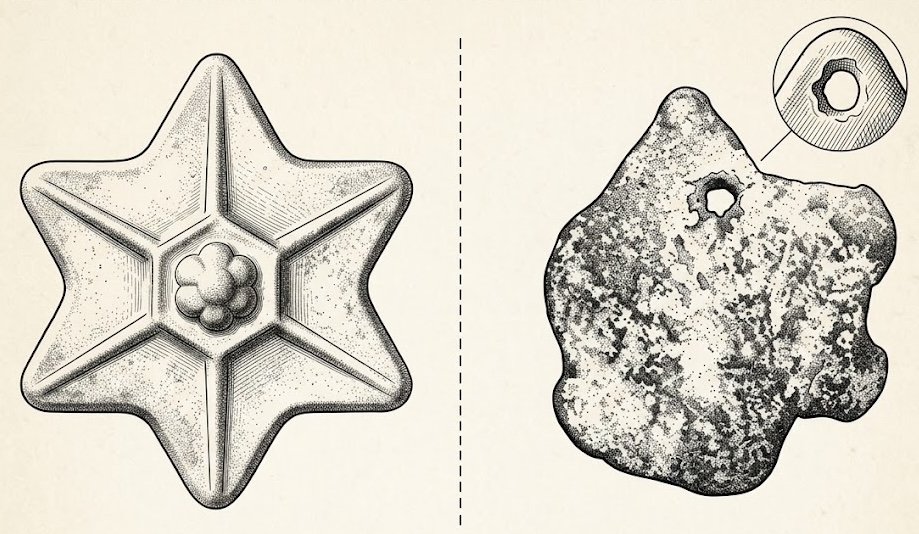
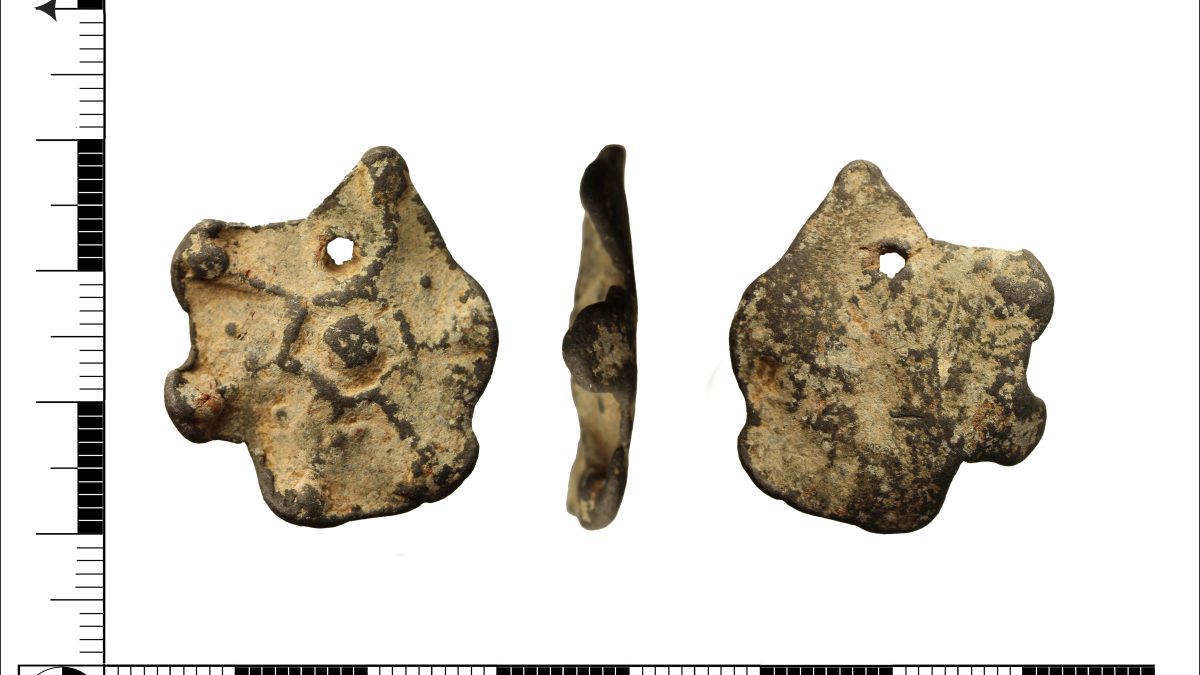
What emerged from the thick grassy topsoil this time was a beautiful medieval riddle: a lead alloy mount or pendant, dating roughly between c. AD 1200 and 1500. While there are patches of heavy clay on this permission, this particular area is used for grazing, featuring about eight inches of rich topsoil sitting right above a dense, flinty layer. It’s this natural flint floor that has kept history within reach, stopping even the heaviest pieces of medieval lead from settling any further over the centuries. As seen in the official record image of WILT-05FA15, the artifact was originally cast as a crisp, symmetrical six-pointed star or hexagonal flower. Only three stubby arms remain intact, each bisected by a raised line meeting a central hexagon and a small boss that mimics the eye of a flower. This specific layout perfectly mirrors the powerful iconography of the period, beautifully blurring the line between a Stella Maris (the Marian Star of the Sea) and a defensive six-petalled hexafoil rosette (meaning its medieval owner likely wore it as a deeply comforting symbol of divine guidance, or as a protective apotropaic charm to ward off evil and misfortune on the road).

The most compelling detail is the crude, off-centre perforation near the top. The reverse is entirely flat, but that punched hole tells a story of local resourcefulness. This piece likely began life as a decorative pendant with a neat casting loop on one of its outer arms. When that soft lead loop inevitably snapped, it wasn’t thrown away. Instead, someone drilled a new hole right through the decorative face just to keep it in service.

Given the volume of lead I’ve recovered here, I’ve developed a theory: this field was once a bustling hub of local commerce tied to the abbey, and it likely hosted at least one artisan or tinkerer working specifically with lead. This star wasn’t just lost; it was likely mended right here on the abbey’s doorstep, serving as a humble reminder of the trade that once thrived just beyond the trees.

Provenance: Downhill from the Augustinian abbey ruins, resting on the sub-surface flint layer

Unique ID: WILT-05FA15

Object Type: Medieval Star-Shaped Mount / Pendant

Date: c. AD 1200–1500

Dimensions: 28.6mm diameter; 3.9mm thickness; 10.08g weight

Gemini_Generated_Image_36wa5z36wa5z36wa

Find 34: A Prefabricated Plaque of Pratten & Co.

A warm, golden late-summer afternoon on the well farmed margins of Farley. It was a peaceful day on this quiet village property, where the light, loamy soil gave way easily to the spade, undisturbed save for the gentle rustle of birds busy among the hedgerow.

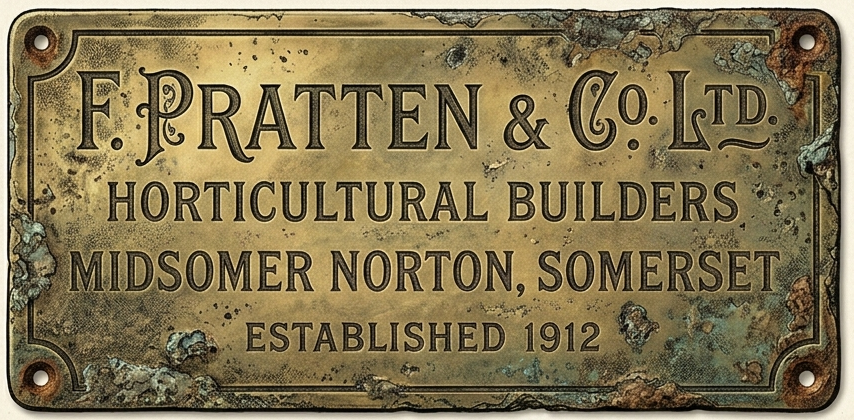
This discovery began as a lesson in looking twice. While detecting in a garden on the edge of the village, my machine let out a somewhat scratchy, broken signal—the typical, unglamorous signature of a piece of modern agricultural iron or scrap tin. It was quite loud and near the surface so I knelt down to flip it out of the turf with a dig tool and what came up was a heavily corroded, rectangle of metal masked in a thick crust of Wiltshire clay and rust. By all rights, it should have gone straight into the scrap-iron bucket destined for the recycling heap yet, as I wiped away the dark grit, my thumb caught the faint, raised contour of lettering. Intrigued, I brought it home to clean it up with a soft brush, slowly revealing a name that tells a fascinating story of British twentieth-century social history: F. Pratten & Co. Ltd. F. Pratten & Co. Ltd. (commonly known as Prattens) was a powerhouse of British prefabricated construction, based out of Midsomer Norton in Somerset. Established by Frank Pratten in 1912 and incorporated in the mid-1920s the firm carved out a monumental reputation as “Horticultural Builders,” becoming a household name for their durable, timber-framed utility buildings. Between the late 1920s and the 1970s—the era from which this small tin tag confidently dates—the company’s catalog of structures touched nearly every corner of rural and civic British life. They manufactured everything from commercial greenhouses and agricultural workshops to poultry “hen huts” for working farms. Most famously, they supplied the iconic timber-framed “Pratten Huts” for the post-war HORSA programme, providing utilitarian, portable classrooms to accommodate the baby-boom generation after the Second World War.

Finding this tag on the edge of a working farm near Farley immediately fired the imagination. I made a mental note to ask the landowner on my next visit if they once had an old ‘Pratten building’ standing on the property. This small, humble plate likely once adorned a sturdy cedar greenhouse, a busy poultry barn, or perhaps even a temporary agricultural workshop that has long since been demolished or scrapped. It shares a wonderful, nostalgic kinship with The Pewter School Bell, which I found not so far away.

I know it may seem strange to some to get so much excitement from a rusty, unremarkable bit of tin that lacks the romance (and lustre) of high antiquity. It has no silver or gold and it is a far cry from the Roman or medieval relics we occasionally coax from the downs. Yet, much like the prefabricated structures it once proudly marked, this little plaque taught me a piece of local industrial heritage I did not know before, offering a brief, tangible window into the practical, working lives of mid-century Wiltshire. That to me, is the real heart of this hobby; it reminds me that every find does indeed tell a story, and the most ordinary objects are often the ones that ground us most deeply in the lived reality of our landscape.

WILT-DC6528_69172984d46f4

Find 33: A Storied Sixpence Scraped from Sheep Pen Soil

An unseasonably warm mid-May morning hung over the Wiltshire downs, free from the previous week’s frost. Instead of wild garlic or damp chalk, the heavy, earthy presence of sheep and cattle dominated the air, grounding the day in working farmland.

This discovery hinged entirely on waiting out the agricultural calendar. The pasture had been out of bounds during the spring lambing season, but when the livestock were finally moved, I stumbled upon a stroke of luck. The landowner had recently scraped away several inches of topsoil to repair a muddy spot elsewhere on the farm, granting my detector extra access into the undisturbed historic subsoil below.

Barely thirty minutes into the session, my headphones filled with the sweet, high-pitched tone of high-purity silver. Kneeling in the exposed earth, I barely had to dig. Resting in the loose soil was a thin, circular disc, its bright metallic lustre winking through the caked dirt as I rubbed it with my thumb. While analyzing the find, the landowner passed by walking her dogs. Delighted to have unearthed something shiny after a dry spell, I presented her with the newly discovered coin. Fresh from the soil, its worn face was obscured, but it was clearly a hard-worked piece of historical silver.

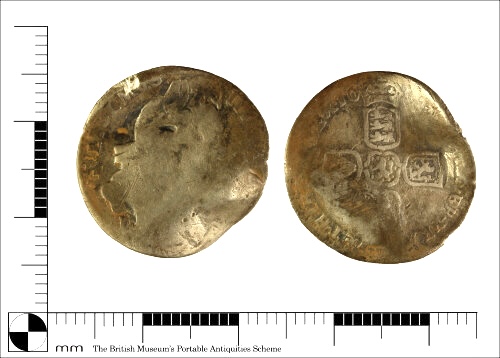
A formal assessment by the Salisbury Museum under record WILT-DC6528 identified the artifact as a post-medieval milled silver sixpence of William III, dated to AD 1696. The obverse features the king’s first draped bust, while the reverse displays four crowned cruciform shields with an early Irish harp. Crucially, a faint, worn ‘Y’ mintmark below the bust indicates it was struck at the short-lived provincial mint in York. I’m amazed how much they gleaned about it after categorizing its physical wear as “Very worn; fair.”

The coin’s warped, wavy surfaces tell a story of physical survival beneath flinty clay and heavy tread. The portrait is worn nearly flat, leaving only the soft outline of a nose and crown. Struck after Queen Mary’s death in 1694, the image of William presented alone on the obverse speaks to a solitary monarch guiding a nation through bitter European conflicts and financial panic.

This sixpence was a direct survivor of the Great Recoinage of 1696–1697, an ambitious effort that replaced clipped, hand-hammered currency with machine-struck milled silver. Yet holding it inspires a deeply personal line of thought. Unlike hoarded gold, a silver sixpence was the money of everyday existence—used to pay daily wages, purchase supplies, or settle tabs at local inns. Its extensive wear suggests it worked hard for decades, changing hands thousands of times through the reigns of Queen Anne and the early Georges. It eventually slipped silently into this Wiltshire pasture, perhaps dropped by a shepherd tending ancestors of the very sheep that wander the field today.

WILT-A316E1_67d989da0b184

Find 32: The House of Constantine

The Constantine Nummus

ID: WILT-A316E1

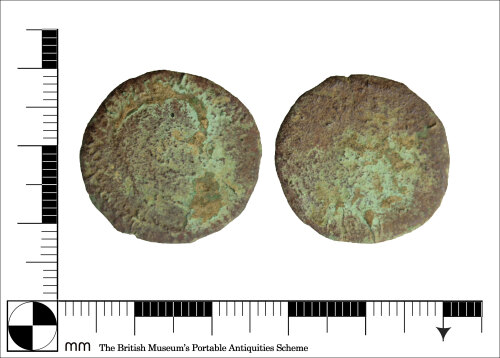
It’s still a big thrill to unearth a piece of imperial history from the soil, even when time has worn its grand design down to a whisper. This complete copper alloy Roman coin dates to the House of Constantine (AD 307–361), a transformative era that saw the rise of Christianity and the founding of Constantinople.

Found just south of Salisbury (known to the Romans as Sorviodunum)—this struck coin weighs 7.28 g and measures 24.5 mm in diameter. It is classified as a nummus (plural: nummi), a Latin term meaning simply “coin.” Archaeologists use the word to describe the low-value, copper-alloy currency minted in vast quantities during the late Empire. In terms of daily purchasing power, its closest modern equivalent would be a low-denomination pocket change coin, like a 5p or 10p piece—the kind of humble money everyday citizens used to buy a loaf of bread or a cup of cheap wine.

Though categorised as extremely worn, it still carries the unmistakable silhouette of Roman authority. The obverse features a right-facing bust adorned with a laureate or pearl diadem, paired with a fragmented inscription reading […]NST[…]—a surviving echo of the Constantinian name. Unfortunately, centuries in the earth have rendered the reverse description and mint mark completely illegible.

This coin serves as a profound reminder that we do not need mint-condition showstoppers to connect with history. Even the dullest, most worn coin can still shed a bit of light onto our growing knowledge of other times and other empires. This humble piece of copper is a vital data point, mapping ancient commerce and proving that even a heavily circulated, obscured fragment can cast a knowing light on Britain’s deep Roman past.

VictorianCandleHolder

Find 31: The Light-Bearer’s Loss

There is a specific kind of gratitude reserved for a neighbour who, amidst the chaos of a garden renovation, remembers the man with the metal detector. A garden near the heart of West Grimstead was being entirely returfed, and the owner kindly invited me to scan the exposed, overturned soil before the new lawn was laid. The day provided those perfect, overcast conditions—that “detecting grey” I so enjoy—where the quiet clarity of the landscape allows for total concentration. While much of the garden yielded the usual modern domestic scatter, a sharp, authoritative signal near the massive, twisted roots of an old oak tree demanded a careful dig.

What I pulled from the dark earth brought an immediate jolt of adrenaline. It appeared to be a heavy, oversized man’s ring, cast in a dark, durable metal. However, it had a curious anatomical quirk: a secondary, jagged tail where the metal had snapped, giving it the appearance of a singular brass knuckle. My mind immediately began to race through the possibilities. Was it a specialized archer’s ring? A piece of primitive trench art? Even the landowner was stumped. It was the closest thing to a ring I had found at that time, and I spent the evening cleaning it with the kind of reverence usually reserved for a more ancient prize.

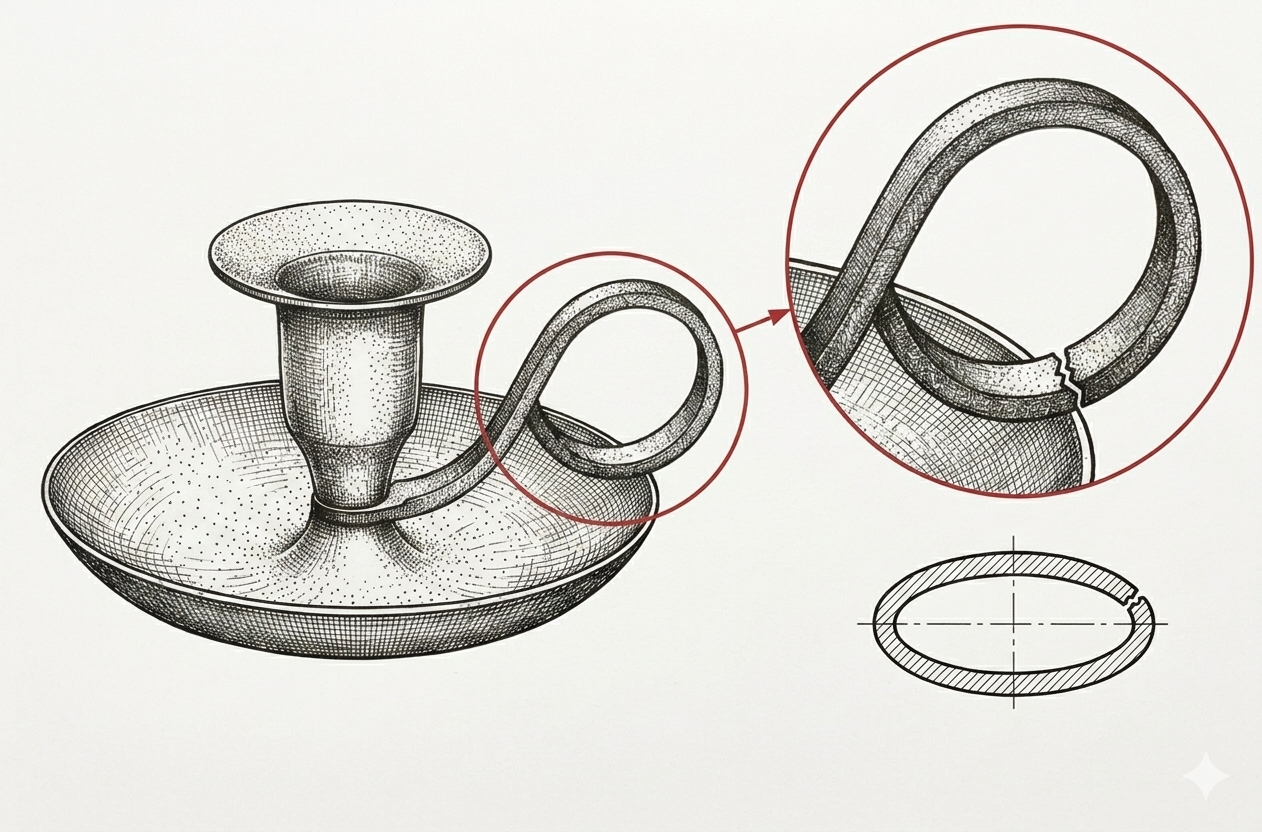
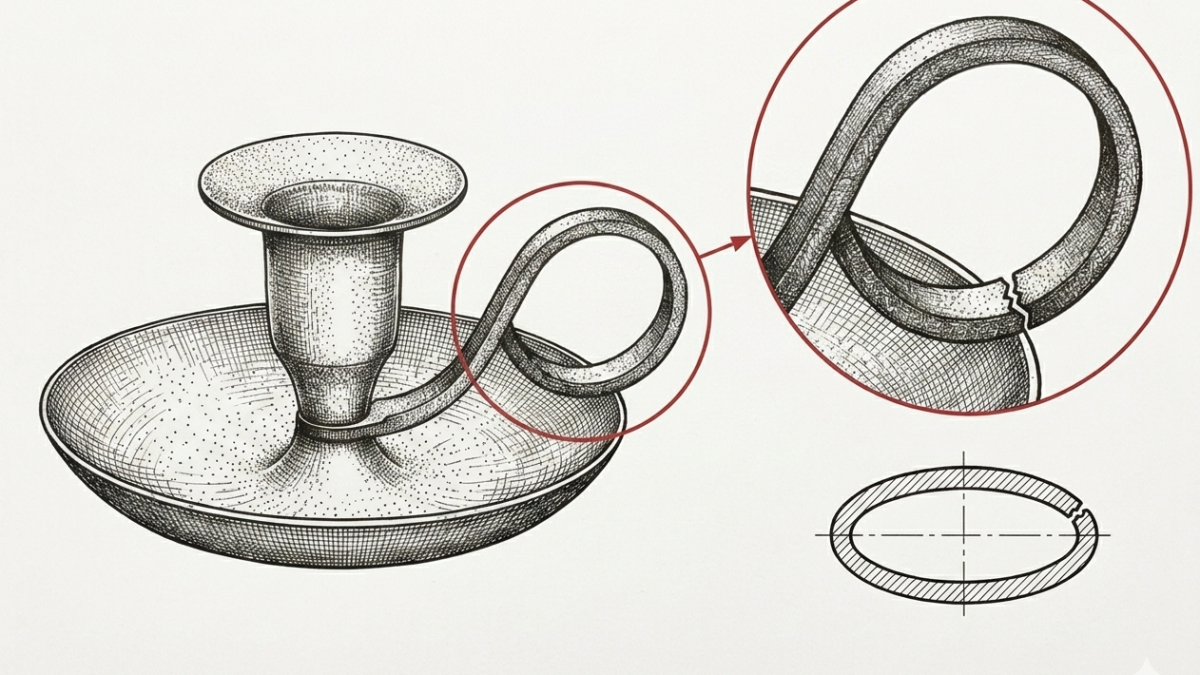
Determined to identify my “ring,” I shared a photograph on a well-known detecting forum. The “boffins” there wasted no time, and I felt that familiar, slightly hot prickle of detecting humility. What I had found was not a ring for a man, but the handle for a flame: the finger-loop from a Victorian chamber candlestick. Once I saw the illustration of a complete holder, the “ring” was instantly transformed. The secondary loop wasn’t for a finger; it was the curved arm that once swept down to join the wide, saucer-like base.

The location, however, is what truly breathes life into the fragment. The oak tree shades what had once been the village spring. Before the arrival of modern plumbing, this was a site of constant activity. I can only imagine a villager making the trip to the water’s edge in the fading light, perhaps during a dry spell or a cold winter evening. It seems likely that the original candlestick was unearthed years ago when the house and garden were first established on this site, and a stout whack on a rock, or perhaps the unforgiving blade of a heavy JCB, snapped the cast metal so cleanly. In that instant, the light literally went out. While the larger, broken pan was likely tossed to the verge by the contractors as debris, this small finger-loop slipped through the cracks, falling deep among the roots of the oak to wait for my coil. This humble artefact is a reminder that in this hobby, the eye often sees what the heart wants, but the truth—a broken tool from a cold Wiltshire morning—is often far more evocative, and a treasure to be sure.


Unique ID:
 [N/A – Non-Reportable]

Object Type: Fragment of a Cast Chamber Candlestick (Finger Loop)

Date: c. 19th Century

Material: Cast Iron / Base Metal

Provenance: Near the old village spring, West Grimstead