
The weeks-long heatwave barely gave us a break, but it did pause to take a humid breath, so of course I was out in the afternoon glare trying to get in a few minutes detecting before the promise of shade and supper called me back home. Just when I thought trudging across the baked soil, on a hillside no less, was not the best way to spend my day, I found something that left me standing in the middle of a hot pasture scratching my head in absolute bewilderment.
I was not far from some forgotten Augustinian ruins when the machine let out an absolute screamer of a signal. It took some effort to punch my spade through the bone-dry soil, but when I flipped the plug up I could see a dense chunk of cast lead with a dull, rugged whitish-grey patina. I nearly threw it straight into my recycling pile, as I’d promised the landowner I’d take away any scrap metal. But when I hosed it off later for a closer look, I noticed a crude raised rim with a hollow, recessed shape. I was holding a fragment of a post-medieval lead casting mould (officially logged as WILT-DB17D8), weighing 116.3 grams and measuring just over 4.6 cm.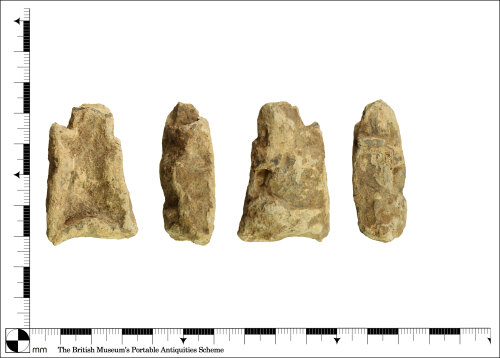
Even our museum experts found it a head-scratcher. The inside face depicts what strongly appears to be a robed human figure with raised, stumpy arms, while the reverse suggests it was part of a two-piece press mould clamped together. Because lead has a low melting point, you cannot pour liquid lead into it without the two fusing. Instead, this block was likely a master reusable mould—a single, clever step in a highly skilled artisan’s lost-wax casting process.
The mould was designed to produce a “blank canvas” body out of warm, soft beeswax. Once the generic robed body was pressed out, the workshop could customise it with ease, much like the famous Apostle spoons of the era. By pinning on separate, hand-carved wooden elements—like praying hands, wings, or a tiny head—before the final multi-stage moulding process, the craftsmen could turn the exact same wax body into a serene angel, a tonsured monk, or a unique saint.
It’s amazing to think that someone sat by a fire or kiln somewhere not far from Clarendon Palace, using this very cavity to press out figure after figure. Was it dropped while working from a temporary roadside marketplace pitch, or simply discarded when the end snapped off, making it too difficult to align properly?
Returned to me by the Finds Liaison Officer, this piece of cottage-industry history now sits safely on my display shelf. It inspires many possibilities as I try to fathom its history, proving that indeed, every find tells a story!
You must be logged in to post a comment.