
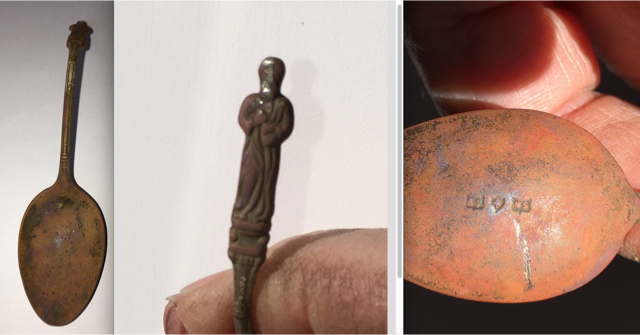
In my last entry, we looked at how early modern metalworkers used clever “modular” casting tricks to customise their wares, drawing a comparison to the famous Apostle spoons of the Tudor and Stuart eras. Reading back over those paragraphs, I realised I hadn’t yet documented one of my earliest and absolute favourite local finds—an actual Apostle spoon! It is a beautiful piece of tableware with a fascinating story to tell, but it hides a cheeky little manufacturing secret that perfectly highlights the line between an ancient relic and a clever Victorian replica.
I found this item way back in 2017, practically my first year out detecting. At the time, I had just the one permission in West Grimstead and absolutely no idea how historically rich a location it would turn out to be. Equipped with a modest, mid-range detector, I slogged my way up to the very top of a sloped pasture. The climb winded me a bit, as I hadn’t yet learned the golden rule of going “low and slow.”
About halfway back down the incline, my machine let out a crazy loud signal. Even though my stomach was rumbling and I was purposefully heading home for lunch, the sheer urgency of the signal stopped me in my tracks. I just had to dig it up. When I peeled back the turf, I pulled out something completely beyond my experience at the time: a delicate little spoon with a tiny, beautifully detailed religious figure perched right on the top. I was absolutely hooked.
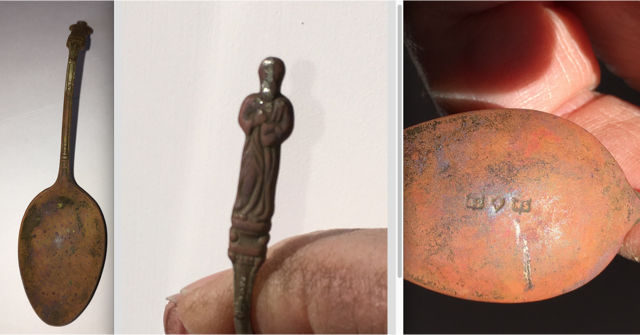
This Electroplated Nickel Silver (EPNS) spoon represents St. James the Greater, and over the decades, its time in the Wiltshire soil has given it a rich, warm, copper-coloured patina. Despite its long sleep, the tiny cast figurine at the top of the handle—known as the “finial”—has survived with remarkable detail. The figure is crowned with a flat, circular halo (historically known as a nimbus) and wears flowing garments. Running down the left side of his robe is a distinct, raised vertical line. In traditional spoon-making, fragile elements like walking sticks were cast flat against the body so they wouldn’t snap off. This is a pilgrim’s staff, identifying him as St. James, the patron saint of pilgrims.
At first glance, finding a spoon depicting a medieval saint near ancient parish paths feels like a ticket straight back to the 16th century! But when I cleaned off the dirt inside the bowl, the maker’s marks told a very different story: EP [♥] NS.
To my untrained eye, these looked like classic 17th-century silver hallmarks. However, this is actually a Victorian pseudo-hallmark. During the late 19th-century Gothic Revival, manufacturers stamped replicas with deceptive marks that were actually clever abbreviations for modern materials: EP for Electroplated, and NS for Nickel Silver.
Because these ornate spoons were traditionally given as christening gifts to be kept as treasured keepsakes, they carried a deep sentimental value. It is incredibly easy to picture a bright Saturday afternoon in the late 1890s, with a local family gathered in the village pasture to celebrate a birth. In the bustling excitement of the outdoor gathering, the prized gift slips off a table and into the deep grass, lost to time until my detector crossed its path 130 years later. It sits proudly on my display shelf today as a fantastic piece of social history—a bridge between the deep medieval past of our parish and the vibrant, close-knit community that shaped West Grimstead at the turn of the century. As my detecting career proceeded, I would soon find that indeed, every find tells a story!