This find came from my absolute favourite—and one of my few—permissions. For a long time, the sheer volume of lead fragments coming out of this single field was a complete mystery. It was only after diving into the local history records that the pieces clicked together: the field sits just downhill from the forgotten ruins of an Augustinian abbey. Today, a thin strip of woodland separates the old abbey grounds from my permission boundary, but centuries ago, that line wouldn’t have existed. While most people today have no idea any of the ruins still stand, the soil remembers. The heavy, unmistakable low-frequency thud of lead in my headphones has become the signature sound of this site.
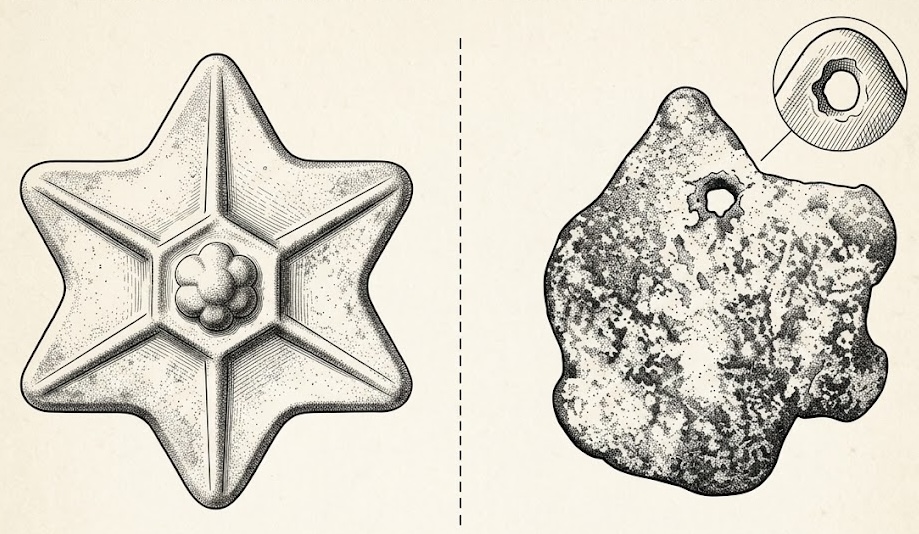
What emerged from the thick grassy topsoil this time was a beautiful medieval riddle: a lead alloy mount or pendant, dating roughly between c. AD 1200 and 1500. While there are patches of heavy clay on this permission, this particular area is used for grazing, featuring about eight inches of rich topsoil sitting right above a dense, flinty layer. It’s this natural flint floor that has kept history within reach, stopping even the heaviest pieces of medieval lead from settling any further over the centuries. As seen in the official record image of WILT-05FA15, the artifact was originally cast as a crisp, symmetrical six-pointed star or hexagonal flower. Only three stubby arms remain intact, each bisected by a raised line meeting a central hexagon and a small boss that mimics the eye of a flower. This specific layout perfectly mirrors the powerful iconography of the period, beautifully blurring the line between a Stella Maris (the Marian Star of the Sea) and a defensive six-petalled hexafoil rosette (meaning its medieval owner likely wore it as a deeply comforting symbol of divine guidance, or as a protective apotropaic charm to ward off evil and misfortune on the road).
The most compelling detail is the crude, off-centre perforation near the top. The reverse is entirely flat, but that punched hole tells a story of local resourcefulness. This piece likely began life as a decorative pendant with a neat casting loop on one of its outer arms. When that soft lead loop inevitably snapped, it wasn’t thrown away. Instead, someone drilled a new hole right through the decorative face just to keep it in service.
Given the volume of lead I’ve recovered here, I’ve developed a theory: this field was once a bustling hub of local commerce tied to the abbey, and it likely hosted at least one artisan or tinkerer working specifically with lead. This star wasn’t just lost; it was likely mended right here on the abbey’s doorstep, serving as a humble reminder of the trade that once thrived just beyond the trees.
Provenance: Downhill from the Augustinian abbey ruins, resting on the sub-surface flint layer