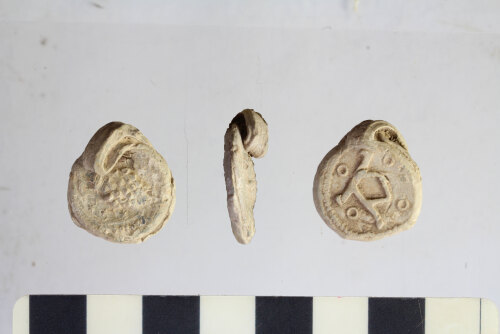
apocaryweight

Find 44: A Wee Dram of History

While metal detectorists often dream of unearthing glittering gold or ancient hammered silver, some of the most fascinating social history comes in small, understated packages. When I first pulled this tiny, square piece of stamped metal from the Wiltshire soil, I assumed it was just a piece of modern farm scrap—perhaps a broken stud, a spacer, or a bit of hardware that had shaken loose from a tractor.

It wasn’t until I got it home, cleaned the dirt away, and examined it closely that the truth revealed itself. There, clearly stamped in a delicate curvilinear script, was the word “Dram” beneath a neat numeral “2”. Far from being tractor scrap, I was holding a complete 18th- or 19th-century apothecary weight.

Measuring just 14mm across and under 5mm thick, this neat square is plain on the reverse, but its obverse bears a clear connection to early medicine. Despite spending nearly two centuries buried deep in the soil, it remains remarkably intact.

PAS Record Summary (WILT-)

Object Type: Modern copper alloy apothecary weight (c. AD 1750–1850)

Inscription: Stamped 2 // Dram in curvilinear script on the obverse; reverse blank.

Measurements: 14.3 mm long × 13.8 mm wide × 4.8 mm thick; weight 6.43 g.

Having discovered the clue of “2 drams”, I got to do my favourite part of this hobby: researching the backstory and further nailing down the use of this find.

Before Britain standardized weights for general trade, physicians, apothecaries, and early veterinarians used a dedicated system of measurement to prepare medicine:

  • 1 Grain = The weight of a single dried grain of wheat.
  • 1 Scruple = 20 Grains.
  • 1 Dram = 3 Scruples (or 60 Grains).
  • 1 Ounce = 8 Drams (or 480 Grains).

This 2 Dram weight represents 120 grains of medicine—or exactly one-quarter of an apothecary’s ounce. Today, two drams equate to roughly 7.78 grams in the modern metric system, though wear and historical regional variations most likely account for this piece sitting at 6.43g.

While it’s easy to picture a human doctor using this, finding it here makes even more sense when considering the land’s history. Before changing its use in the 1970s, this property was a working dairy farm for decades—and likely centuries before that.

The Country Vet in the Pasture

Formal veterinary medicine truly took off during this weight’s era, marked by the founding of the Veterinary College of London in 1791. Early “farrier-surgeons” and country vets used the exact same apothecaries’ weights as human doctors to mix up drenching draughts, powders, and salves for livestock.

On a busy dairy farm, valuable cattle and working horses needed constant care. A visiting vet or farmer attending to sick livestock right out in the pasture would carry handheld balance scales in a saddlebag, mixing remedies on the spot. Precision was vital—even for a cow, an overdose of active ingredients like nitre, sulphur, or antimony could prove dangerous.

Dropping a tiny 14mm brass weight while treating a cow in the open field explains perfectly how it ended up buried in the pasture mud, far from any village street or footpath. It’s a great reminder of why we take the time to inspect every item we dig; what looked like scrap turned out to be a tangible link to the daily healthcare of a historic Wiltshire dairy farm. And a fun ‘deep dive’ into an aspect of Wiltshire history I was only dimly aware of.
annularbrooch

Find 47: Fastened in Time

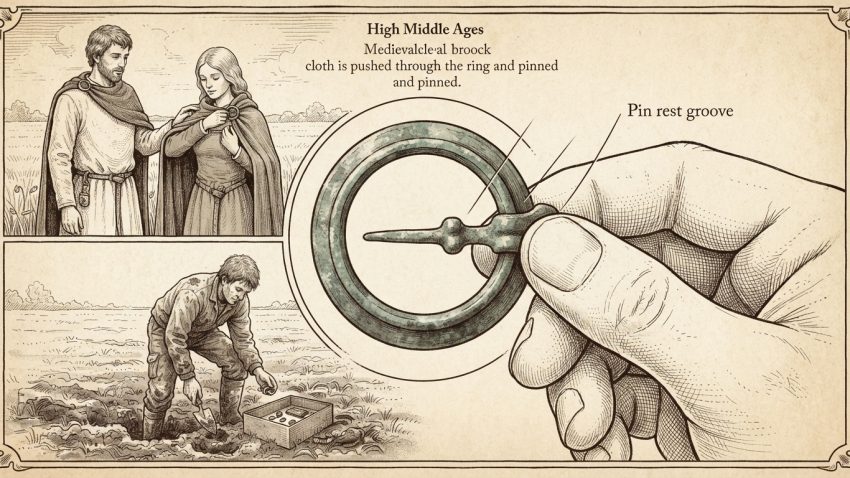
To be honest, this item stayed in my collection for a long time before I finally brought it in to the Finds Liaison Officer. To my untrained eye, it looked a lot like a simple loop from a modern horse harness—the kind of scrap metal that is both too common and too new to report. But I just had a feeling about it. It was that particular patina; it just looked like it held centuries of history. Fortunately, I remembered exactly where I was on the field when I found it, so I packed it into a literal shoebox with other finds and trundled off to the museum. I seriously thought I’d get it back with a note attached: ‘Not Recorded: TOO Modern.’ So imagine my delight to find out it was in fact over 600 years old!

Recorded as WILT-728A87, the FLO confirmed this “simple loop” is actually an incomplete medieval copper-alloy annular (ring) brooch dating between c. AD 1270 and 1350—the era of Edward I and II and the dawn of the Hundred Years’ War.

In the High Middle Ages, long before buttons became standard, wealthy nobles wore silver or gold brooches inlaid with jewels, while everyday folk relied on plain, copper-alloy examples like this one. The reference cited in the finds database record—Dress Accessories c. 1150–c. 1450 from the Museum of London —shows that undecorated, bevelled brooches of this exact size were the absolute workhorses of medieval clothing. Used by men and women alike, these simple circular frames held tunics, cloaks, and chemises together at the neck or shoulder.

To wear one, a person gathered a lump of cloth up through the center of the ring, pushed the pin point through the fabric, and pulled the ring back down so the pin rested flat against the frame, keeping the garment secured under tension without tearing it.

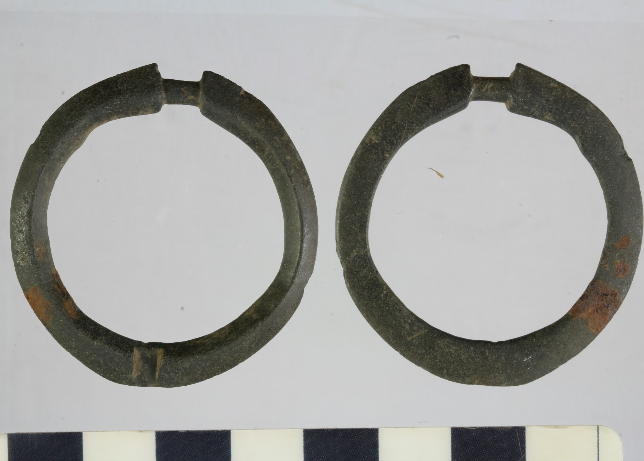
Though missing its original pin—which would have been a thin copper-alloy wire that snapped, or an iron pin that rusted away in the soil—my brooch still sports that distinct, smooth grey-green surface patina that speaks of over seven centuries in the ground. The outer edge is subtly bevelled, angling down to a flat inner surface. On one side, the frame narrows into a 5.9mm pin constriction where the pin hinge once rested. Directly across from it lies a small, rectangular groove—the pin rest designed to catch the tip under tension.

Losing a brooch in a 13th- or 14th-century field meant a loose tunic or a mantle coming undone on a cold Wiltshire morning. Holding it now, I’m glad I trusted my gut—what looked like a scrap harness ring turned out to be a genuine piece of medieval everyday life, its story preserved in the soil for over 650 years.

Find 22: The Master’s Mark
Find 16: The Great Recoinage of William III
Screenshot 2026-08-07 at 10.44.25

Find 46: A Matter of Scale

It really is amazing how a simple piece of lead pulled out of a muddy field can instantly connect our modern, everyday routines—like standing on a clinic scale—straight back through the Roman Empire to Archimedes, the father of modern physics. Every time I go to the doctor’s office for a checkup, I’m weighed and while waiting for the cantilevering to stop I think about the mechanics of the scale they use. There is no massive, 150-pound iron weight (or two!) involved. Instead, the nurse slides a small metal weight along a notched beam until it balances horizontally. By using leverage, that tiny weight can balance a person’s entire body weight. This is time-tested technology, as evidenced by a small, heavy piece of grey metal I rescued from the Dun valley soil last month.

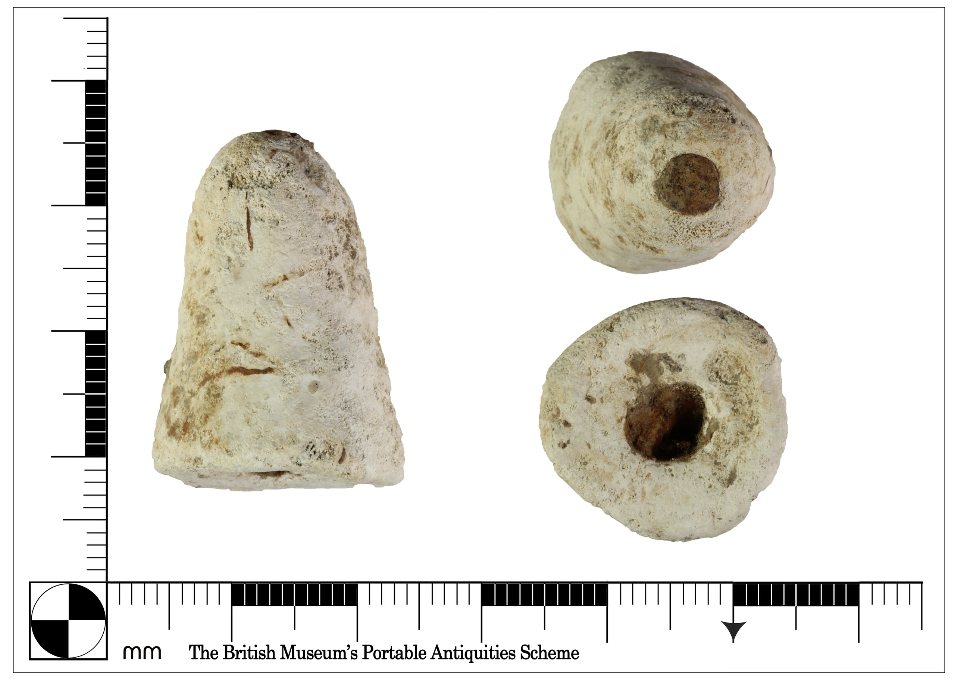
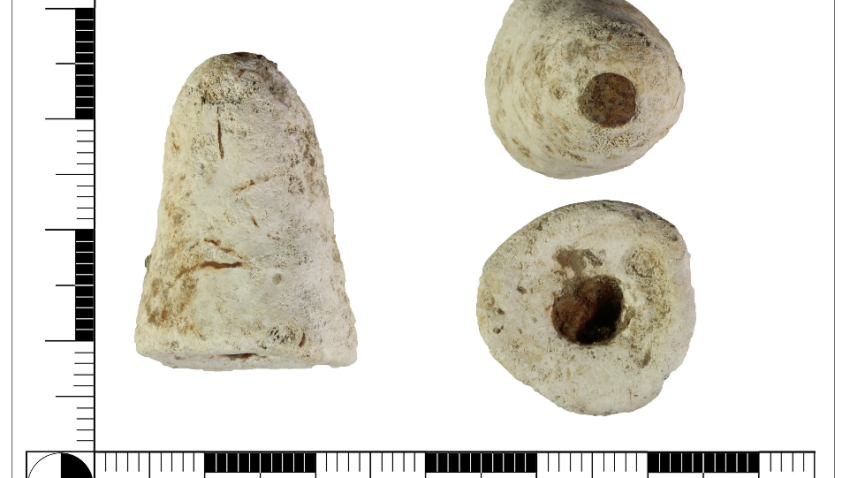
Recorded by the Finds Liaison Officer as an incomplete conical lead steelyard weight (PAS ID: WILT-0401DC), this simple object dates anywhere from the early Roman period right through to the Middle Ages (c. AD 43–1350). Standing just under 30 mm tall, it features a classic conical shape, cast with a hole running through its center. Inside that piercing at both top and bottom, you can still see the iron rust stubs of the original suspension loop that once held it to a metal beam.

Carrying a heavy set of fixed weights for traditional balance scales was impractical for traveling traders and merchants. Instead, they used a steelyard scale (statera), which relied on a single movable weight and a notched beam.
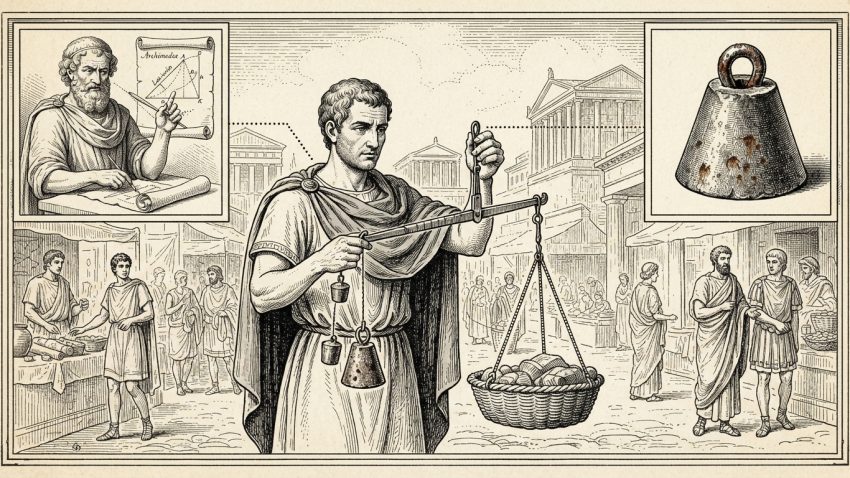
While these are often called “Roman balances,” the Romans actually adopted the technology from the Greeks, who developed it around the 4th to 3rd century BC using Archimedes’ principles of levers. Recognizing how useful these lightweight scales were for trade and the military, the Romans standardized the design and it spread to the ends of the Empire—which is why so many of these weights are found all over Britain.

Despite centuries of agricultural wear and the loss of its iron hanging loop, this weight sits at 54.46 grams.
In the Roman measurement system, the standard pound (libra) was divided into 12 ounces (uncia), with a single uncia weighing roughly 27.41 grams. Multiply that by two, and you get 54.82 grams—meaning this weight, even today, sits less than 1% off an exact 2 Roman Ounces (Sextans / 2 Unciae). The fraction of a gram missing is easily accounted for by the iron wire that rusted away inside the central core.

Whether used by a Romano-British trader or a medieval merchant carrying on an age-old tradition, this simple piece of lead was a crucial tool of everyday commerce, turning Greek lever mechanics into fair trade across Europe, and to our local fields.

Gemini_Generated_Image_ej7t77ej7t77ej7t

Find No. 42: A simple Pattern of Pattens

Thinking about the area around St John’s Church brought to mind a recurring type of find from my early days of detecting. I once had permission to search a tiny field barely a stone’s throw from the back of the church itself. Back then, my first detector wasn’t all that sophisticated, meaning big, chunky iron targets were hard to miss—and among those early recoveries from that little patch of ground were several oval iron rings. Having only recently learned that farmers historically shoed oxen as well as horses, I initially wondered if these odd iron loops were custom shoes for miniature ponies! Having since learned what they actually are, I think I can be forgiven for that somewhat less-than-enlightened jump in logic. They weren’t made for livestock at all—they were made for human feet. These are shoe pattens.

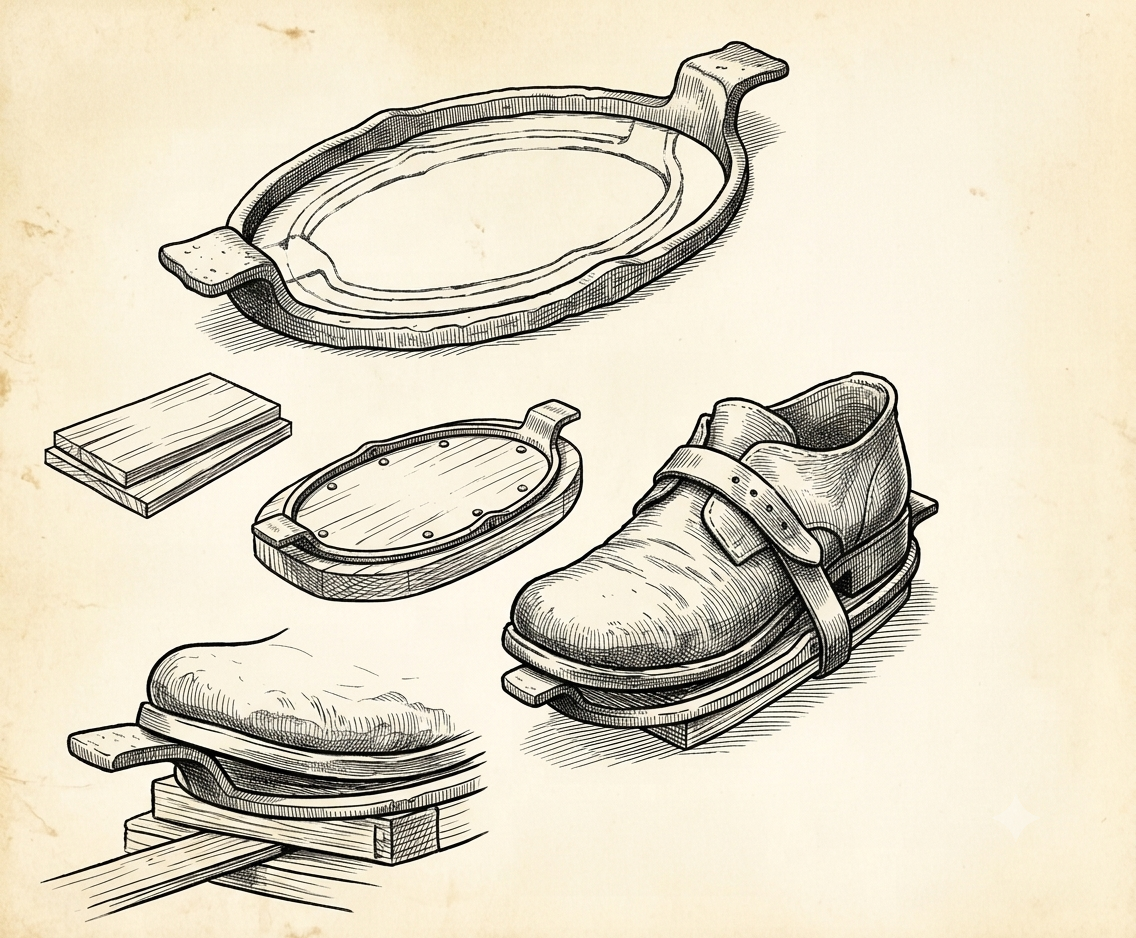
A patten was an overshoe consisting of an oval iron ring riveted to a wooden sole, which was then strapped beneath a person’s normal leather footwear. Functioning like personal mud-stilts, this unwieldy, noisy contraption raised the wearer’s shoes above dirty streets and flooded country tracks. They were famously clattery, so much so that many churches and homes with stone floors explicitly banned wearing them indoors—leaving visitors to unstrap them at the porch before stepping inside.

This particular example is an incomplete post-medieval iron foot patten, dating from between c. 1720 and c. 1900. It features an oval ring, rectangular in cross-section, with raised platforms at both the heel and toe. The trapezoidal heel plate and circular toe plate each retain two rivet holes where iron fasteners once held the wooden sole in place. Though corroded, it is structurally complete; even a tapering iron fragment that broke off the front edge in antiquity was successfully recovered from the soil. Despite its wear, it remains a substantial piece of local history, measuring 164mm in length, 81mm in width, and weighing just under 120 grams combined.
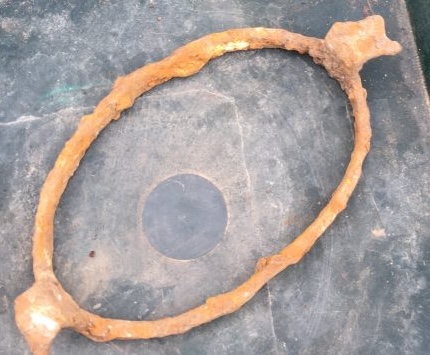
Pattens with plain oval hoops superseded earlier crinkled 17th-century designs around c. 1720 (Bailey, 1995; Goodall, 1976).

After uncovering my fourth or fifth patten from that single small patch of ground, it’s easy to picture how they ended up buried in the soil. Perhaps an annoyed rector, utterly vexed by the endless clatter of iron on church flagstones during the sermon, scooped up the discarded pile from the porch and tossed them over the boundary wall into the field out back. Or perhaps, more simply, after a damp morning service, the weather cleared up. I like to think of the congregation leaving St John’s smiling in the warm afternoon sunshine, stepping onto drying paths with their need for heavy, mud-defying iron shoes long forgotten—leaving their clanking pattens behind to be claimed by the earth centuries later.

WILT336B57

Find No. 39: Off the Hook

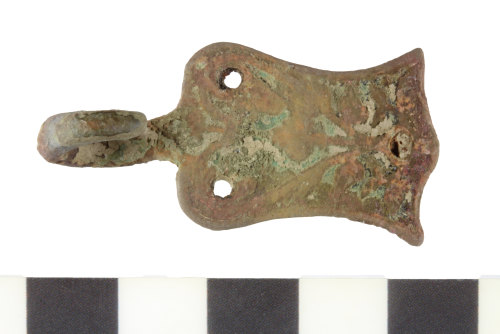
When I documented a medieval clasp in a previous entry, I made a brief passing reference to another favourite piece from my collection—a post-medieval hooked strap fitting. Measuring 44mm long and weighing just under seven grams, this copper-alloy piece (logged under PAS reference WILT-336B57) dates from between AD 1550 and 1700, spanning the dramatic Tudor and Stuart eras.

I found this item in the very same West Grimstead field that yielded a rich assortment of Tudor and Stuart discoveries—a dress fastener, bag seal, star pendant, leather palm guard, lead beads, and a lead cloth seal originating all the way from Augsburg, Germany. I don’t often stop to picture local life 600 years ago, but this variety suggests a landscape bustling with all classes of people. In the 1500s, West Grimstead was a quiet parish of just 200 souls, ruled by lords descended from the de Grimstede line. The only landmark I would recognize today is St John’s Church, already two centuries old back then. Yet lords, soldiers, merchants, and farmhands all passed through these pastures—and St John’s was the one constant every single one of them would have walked past.

Despite long sleep in the Wiltshire soil, the fitting is complete and survived with crisp detail. It features an elegantly shaped body with concave sides, a flaring “fish-tail” attachment end, and an integral forward-facing hook projecting from its rounded tip. The surface is decorated with a raised foliate motif—a classic Tudor floral design—and tucked into the far end is the iron-stained remnant of its original rivet.

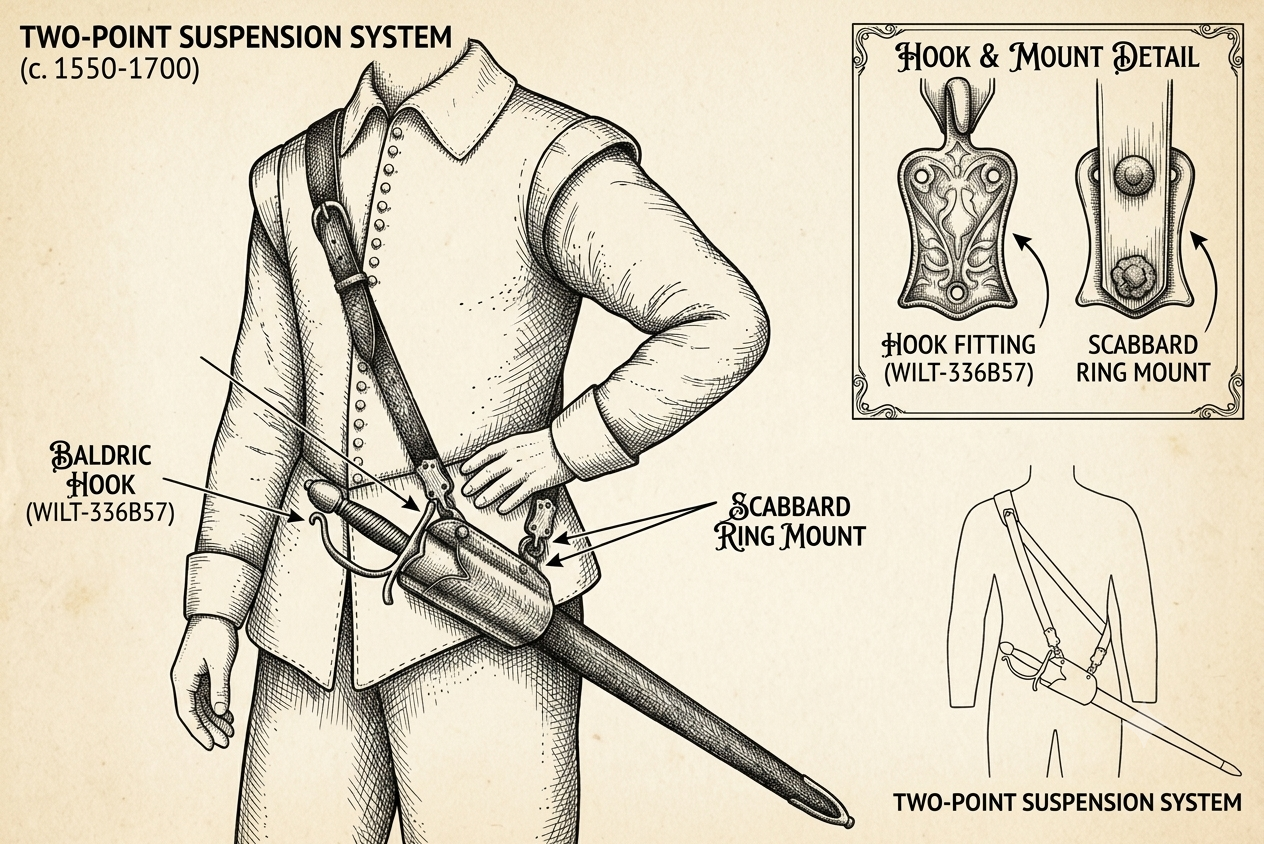
While small hooks like this can easily be mistaken for horse harness fittings, experts point toward a far more exciting function: a hanger fitting from a post-medieval sword belt or baldric.

During the 16th and 17th centuries, gentlemen and soldiers wore heavy rapiers suspended from leather shoulder belts. Rather than permanently buckling the heavy weapon to the leather harness, craftsmen used clever hooked fittings like this one. The plate was riveted securely to the leather strap, allowing the wearer to quickly hook and unhook their sword scabbard when stepping indoors or mounting a horse.  The single hook I found was almost certainly one half of a matching pair (or trio) that together kept a rapier balanced right at a gentleman’s side! It is easy to picture a Tudor traveller or Civil War soldier riding across those West Grimstead pastures, the weight of their scabbard bouncing against this very hook. Over time, the strain sheared the iron rivet, leaving this ornate bit of military hardware behind in the dirt.

Having been recorded by the museum and returned to my care, it sits on my shelf today as a brilliant reminder of the history woven into our village fields—proving once again that every find (or finds in this case) tells a story!
spoon2017-04-22-

Find 37: Relic or Replica?

In my last entry, we looked at how early modern metalworkers used clever “modular” casting tricks to customise their wares, drawing a comparison to the famous Apostle spoons of the Tudor and Stuart eras. Reading back over those paragraphs, I realised I hadn’t yet documented one of my earliest and absolute favourite local finds—an actual Apostle spoon! It is a beautiful piece of tableware with a fascinating story to tell, but it hides a cheeky little manufacturing secret that perfectly highlights the line between an ancient relic and a clever Victorian replica.

I found this item way back in 2017, practically my first year out detecting. At the time, I had just the one permission in West Grimstead and absolutely no idea how historically rich a location it would turn out to be. Equipped with a modest, mid-range detector, I slogged my way up to the very top of a sloped pasture. The climb winded me a bit, as I hadn’t yet learned the golden rule of going “low and slow.”

About halfway back down the incline, my machine let out a crazy loud signal. Even though my stomach was rumbling and I was purposefully heading home for lunch, the sheer urgency of the signal stopped me in my tracks. I just had to dig it up. When I peeled back the turf, I pulled out something completely beyond my experience at the time: a delicate little spoon with a tiny, beautifully detailed religious figure perched right on the top. I was absolutely hooked.

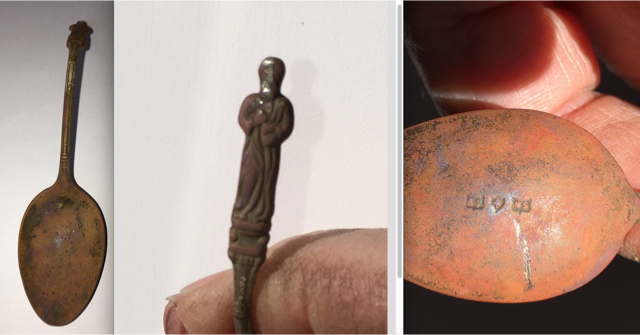
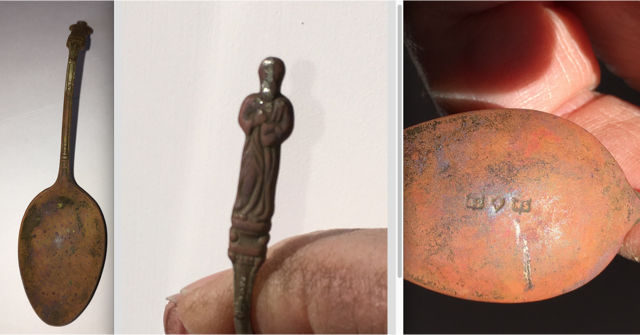
This Electroplated Nickel Silver (EPNS) spoon represents St. James the Greater, and over the decades, its time in the Wiltshire soil has given it a rich, warm, copper-coloured patina. Despite its long sleep, the tiny cast figurine at the top of the handle—known as the “finial”—has survived with remarkable detail. The figure is crowned with a flat, circular halo (historically known as a nimbus) and wears flowing garments. Running down the left side of his robe is a distinct, raised vertical line. In traditional spoon-making, fragile elements like walking sticks were cast flat against the body so they wouldn’t snap off. This is a pilgrim’s staff, identifying him as St. James, the patron saint of pilgrims.

At first glance, finding a spoon depicting a medieval saint near ancient parish paths feels like a ticket straight back to the 16th century! But when I cleaned off the dirt inside the bowl, the maker’s marks told a very different story: EP [♥] NS.

To my untrained eye, these looked like classic 17th-century silver hallmarks. However, this is actually a Victorian pseudo-hallmark. During the late 19th-century Gothic Revival, manufacturers stamped replicas with deceptive marks that were actually clever abbreviations for modern materials: EP for Electroplated, and NS for Nickel Silver.

Because these ornate spoons were traditionally given as christening gifts to be kept as treasured keepsakes, they carried a deep sentimental value. It is incredibly easy to picture a bright Saturday afternoon in the late 1890s, with a local family gathered in the village pasture to celebrate a birth. In the bustling excitement of the outdoor gathering, the prized gift slips off a table and into the deep grass, lost to time until my detector crossed its path 130 years later. It sits proudly on my display shelf today as a fantastic piece of social history—a bridge between the deep medieval past of our parish and the vibrant, close-knit community that shaped West Grimstead at the turn of the century. As my detecting career proceeded, I would soon find that indeed, every find tells a story!