
An unseasonably warm mid-May morning hung over the Wiltshire downs, free from the previous week’s frost. Instead of wild garlic or damp chalk, the heavy, earthy presence of sheep and cattle dominated the air, grounding the day in working farmland.
This discovery hinged entirely on waiting out the agricultural calendar. The pasture had been out of bounds during the spring lambing season, but when the livestock were finally moved, I stumbled upon a stroke of luck. The landowner had recently scraped away several inches of topsoil to repair a muddy spot elsewhere on the farm, granting my detector extra access into the undisturbed historic subsoil below.
Barely thirty minutes into the session, my headphones filled with the sweet, high-pitched tone of high-purity silver. Kneeling in the exposed earth, I barely had to dig. Resting in the loose soil was a thin, circular disc, its bright metallic lustre winking through the caked dirt as I rubbed it with my thumb. While analyzing the find, the landowner passed by walking her dogs. Delighted to have unearthed something shiny after a dry spell, I presented her with the newly discovered coin. Fresh from the soil, its worn face was obscured, but it was clearly a hard-worked piece of historical silver.
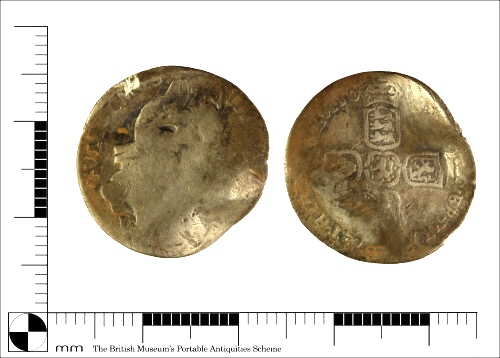
A formal assessment by the Salisbury Museum under record WILT-DC6528 identified the artifact as a post-medieval milled silver sixpence of William III, dated to AD 1696. The obverse features the king’s first draped bust, while the reverse displays four crowned cruciform shields with an early Irish harp. Crucially, a faint, worn ‘Y’ mintmark below the bust indicates it was struck at the short-lived provincial mint in York. I’m amazed how much they gleaned about it after categorizing its physical wear as “Very worn; fair.”
The coin’s warped, wavy surfaces tell a story of physical survival beneath flinty clay and heavy tread. The portrait is worn nearly flat, leaving only the soft outline of a nose and crown. Struck after Queen Mary’s death in 1694, the image of William presented alone on the obverse speaks to a solitary monarch guiding a nation through bitter European conflicts and financial panic.
This sixpence was a direct survivor of the Great Recoinage of 1696–1697, an ambitious effort that replaced clipped, hand-hammered currency with machine-struck milled silver. Yet holding it inspires a deeply personal line of thought. Unlike hoarded gold, a silver sixpence was the money of everyday existence—used to pay daily wages, purchase supplies, or settle tabs at local inns. Its extensive wear suggests it worked hard for decades, changing hands thousands of times through the reigns of Queen Anne and the early Georges. It eventually slipped silently into this Wiltshire pasture, perhaps dropped by a shepherd tending ancestors of the very sheep that wander the field today.
You must be logged in to post a comment.