
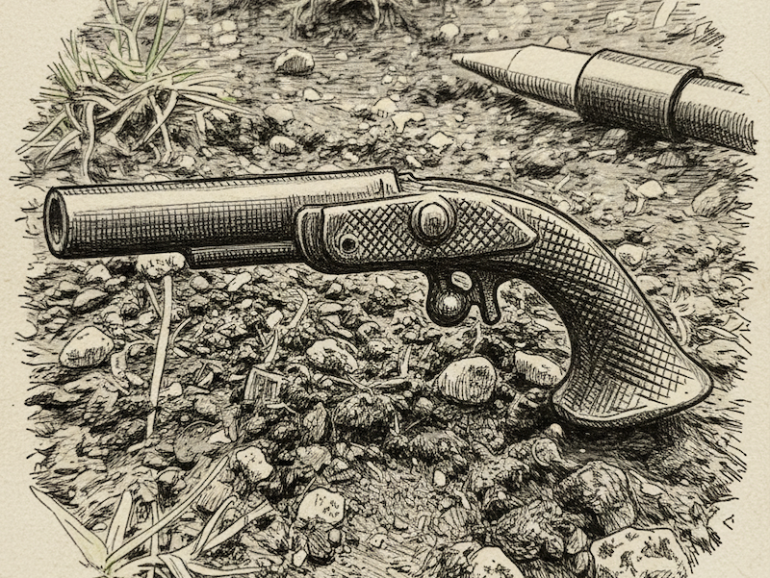
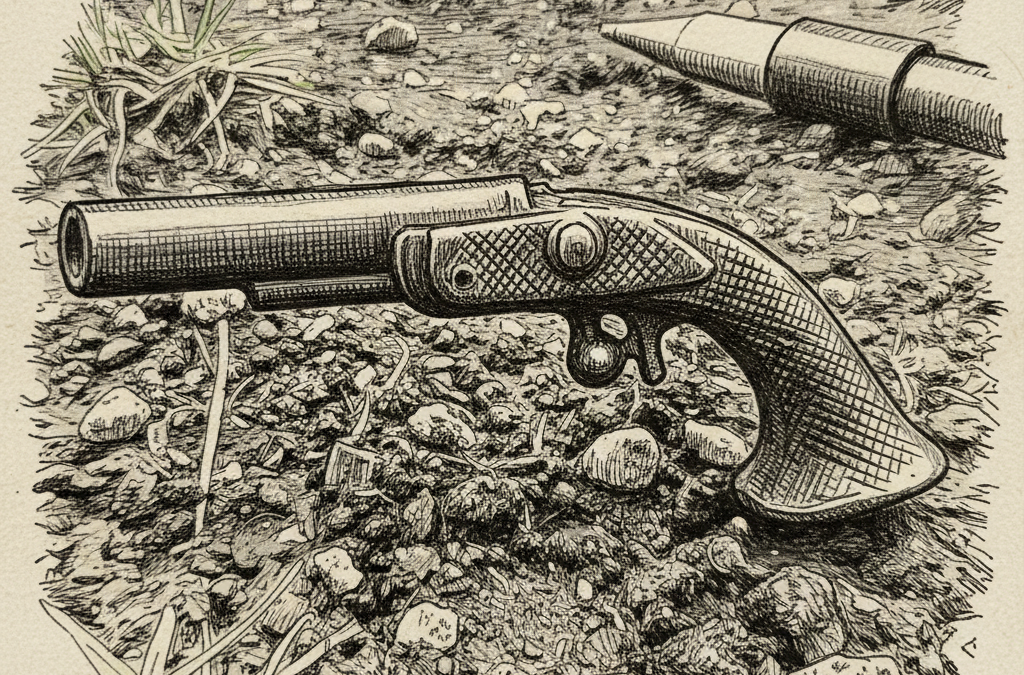
Victorian-style illustration of the East Grimstead Petronel, generated by Gemini
🌱 A Heavy Little Mystery
I have a small permission in East Grimstead, and while it is a short walk from known Roman ruins, the soil here mostly yields items from the post-medieval period up to the Victorian era. The River Dun flows nearby, and I was following a footpath uphill from the water when I caught a solid, high-tone signal.
I pulled out what looked like a curved bit of lead with some interesting etchings on it. My first thought was that it was a fragment of a handle or decorative furniture fitting. It was small—barely over 50mm long—but surprisingly heavy. Once I cleared away the damp river-valley earth, the unmistakable shape of a pistol emerged. This wasn’t a modern toy; it was a cast lead petronel-style toy pistol.
🔨 The Craftsmanship of Play
The object is a remarkable piece of 17th-century craftsmanship, still holding a deep, blackish-grey patina after hundreds of years in the soil. At just 53.1mm long and weighing a solid 14.4g, it feels substantial in the hand, more like a tool than a trinket. The design is a faithful miniature of the full-sized “petronel”—a firearm favored by cavalry during the 1500s and 1600s. Its circular barrel is hollow, tapering into an integral flared stock that, like the barrel itself, is decorated with delicate, incised cross-hatching. There is even a small lead “knop” beneath the frame to represent the trigger, showing just how much care went into creating a replica that mirrored the high-status weapons of the day.
✨ Reflections: A Dangerous Plaything?
The most fascinating aspect of these toys is that they were often fully working models. A child would have been able to pour a tiny amount of gunpowder into the hollow barrel and ignite it through a touch-hole. While this seems terrifying by modern standards, we shouldn’t judge the gift of such a toy too harshly. In the 1600s, children were treated as “small adults” in training; play was a direct rehearsal for the realities of adulthood, whether for military service or hunting.
I searched in a wide circle for the rest of the gun but found no other fragments. A good portion of the piece is missing, leaving me to wonder if it was tossed away by a parent wearied by the retort it no doubt made, or discarded because a misfire caused actual harm.
The wear on the lead suggests it was well-loved before it was lost. To hold a toy that a child played with 300 years ago—perhaps mimicking the soldiers passing through the valley or learning the hunting skills they would soon need—provides a more intimate connection to the past than any buckle or button. It is a tiny, leaden echo of a 17th-century childhood, dropped on a hillside that takes only two minutes to walk today, but took several centuries to return to the knowledge of men.



You must be logged in to post a comment.