
The steep, wooded boundary of a Wiltshire village offers a particular kind of resistance; the incline demands a slow, deliberate pace while I manoeuvre the detector between hedge roots and patches of nettles. On this morning, the silence of the Dun Valley was punctured by a sudden, piercing high-frequency zing—the kind of unapologetic, brassy shout that usually signals a discarded modern aluminum can. Yet, there was an unmistakable acoustic “weight” to the signal, a breadth of tone that refused the hollow vibrato of refuse. Digging six inches through the yielding loam to the hard, rocky core of the hillside, I found not the expected scrap, but the tarnished gold-glimmer of a heavy, yellow-metal plated copper alloy case.
Buried about six inches down, I found it resting exactly where the deep loam ends and the rocky core of the terrain begins. Formally recorded as WILT-5DC6D8, the object is an incomplete demi-hunter pocket watch, a quintessential piece of English horology dating to c. 1750–1800$. Featuring a substantial verge fusee movement held between two brass plates, the watch possesses a stem at the 12 o’clock position without an integrated winder, a hallmark of its era. The enamel face, though crazed by centuries of soil pressure, retains a singular, arrow-headed hour hand. Etched on the internal workings, the inscription is remarkably legible: “James Wild LONDON”, accompanied by the serial number 3952. Inside the casing, a fragment of textile adheres to the metal, the ghost of a “watch paper” that once carried the maker’s advertisement.
A demi-hunter (or half-hunter) is a design where the outer lid has a central hole (originally with a glass crystal) allowing the owner to read the time without opening the case. The name originates from English fox hunters who needed to check the time without letting go of their horse’s reins. The back of the case features an heraldic shield with a diagonal band and vertical hatchings. Inside the case is a strip of what appears to be textile adhering to the metal. The watch features a verge fusee movement held between two brass plates.
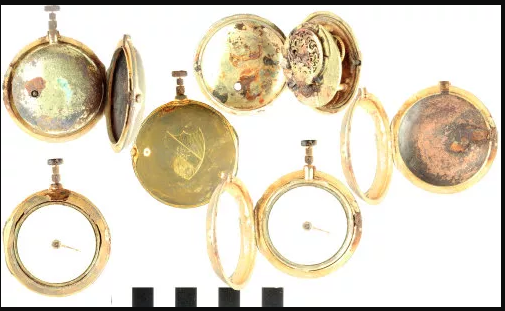
I found that guild records actually confirm that a James Wild was a documented watchmaker active in the late 18th century, working out of Frith Street, Soho, London, around 1790. In the late 1700s, Soho was a hub for highly skilled artisans and luxury trades. Having a watch signed with a “London” address indicates that this was a high-quality piece of its time, likely sold to a customer of significant means.
The serial number 3952 suggests that Wild ran a successful workshop. In the 18th century, such numbers often indicated a master who finished and signed standardized “batches” of movements. The Verge Fusee mechanism itself was the gold standard for English timepieces at the time, known for its thickness and durability—which explains the “weight” I felt when I first pulled it from the turf.
Over several seasons, I have recovered additional watch parts and internal mechanisms from this same field. While none have reached the completeness of the James Wild piece, their presence suggests that this was not a random, isolated loss, but perhaps a thief’s desperate scramble through the undergrowth, carelessly dropping bits of a stolen hoard.
There is something haunting about a watch that has stopped; with the numbers no longer visible and only a single hand remaining, stuck near the four o’clock position, it remains a silent witness to a moment of misfortune. Finding this piece feels less like archaeology and more like a recovery. To Wild’s customer in the late 1700s, it was a lost investment; to me, it is a preserved moment of history, blending the quiet heritage of a village far from London with the industrial records of a time lost to the streets of Soho.
You must be logged in to post a comment.