Find 52:  Twenty shells later…
Find 51: Token Silver
Photo of the Day: September 14th, 2026
apocaryweight

Find 44: A Wee Dram of History

While metal detectorists often dream of unearthing glittering gold or ancient hammered silver, some of the most fascinating social history comes in small, understated packages. When I first pulled this tiny, square piece of stamped metal from the Wiltshire soil, I assumed it was just a piece of modern farm scrap—perhaps a broken stud, a spacer, or a bit of hardware that had shaken loose from a tractor.

It wasn’t until I got it home, cleaned the dirt away, and examined it closely that the truth revealed itself. There, clearly stamped in a delicate curvilinear script, was the word “Dram” beneath a neat numeral “2”. Far from being tractor scrap, I was holding a complete 18th- or 19th-century apothecary weight.

Measuring just 14mm across and under 5mm thick, this neat square is plain on the reverse, but its obverse bears a clear connection to early medicine. Despite spending nearly two centuries buried deep in the soil, it remains remarkably intact.

PAS Record Summary (WILT-)

Object Type: Modern copper alloy apothecary weight (c. AD 1750–1850)

Inscription: Stamped 2 // Dram in curvilinear script on the obverse; reverse blank.

Measurements: 14.3 mm long × 13.8 mm wide × 4.8 mm thick; weight 6.43 g.

Having discovered the clue of “2 drams”, I got to do my favourite part of this hobby: researching the backstory and further nailing down the use of this find.

Before Britain standardized weights for general trade, physicians, apothecaries, and early veterinarians used a dedicated system of measurement to prepare medicine:

  • 1 Grain = The weight of a single dried grain of wheat.
  • 1 Scruple = 20 Grains.
  • 1 Dram = 3 Scruples (or 60 Grains).
  • 1 Ounce = 8 Drams (or 480 Grains).

This 2 Dram weight represents 120 grains of medicine—or exactly one-quarter of an apothecary’s ounce. Today, two drams equate to roughly 7.78 grams in the modern metric system, though wear and historical regional variations most likely account for this piece sitting at 6.43g.

While it’s easy to picture a human doctor using this, finding it here makes even more sense when considering the land’s history. Before changing its use in the 1970s, this property was a working dairy farm for decades—and likely centuries before that.

The Country Vet in the Pasture

Formal veterinary medicine truly took off during this weight’s era, marked by the founding of the Veterinary College of London in 1791. Early “farrier-surgeons” and country vets used the exact same apothecaries’ weights as human doctors to mix up drenching draughts, powders, and salves for livestock.

On a busy dairy farm, valuable cattle and working horses needed constant care. A visiting vet or farmer attending to sick livestock right out in the pasture would carry handheld balance scales in a saddlebag, mixing remedies on the spot. Precision was vital—even for a cow, an overdose of active ingredients like nitre, sulphur, or antimony could prove dangerous.

Dropping a tiny 14mm brass weight while treating a cow in the open field explains perfectly how it ended up buried in the pasture mud, far from any village street or footpath. It’s a great reminder of why we take the time to inspect every item we dig; what looked like scrap turned out to be a tangible link to the daily healthcare of a historic Wiltshire dairy farm. And a fun ‘deep dive’ into an aspect of Wiltshire history I was only dimly aware of.
annularbrooch

Find 47: Fastened in Time

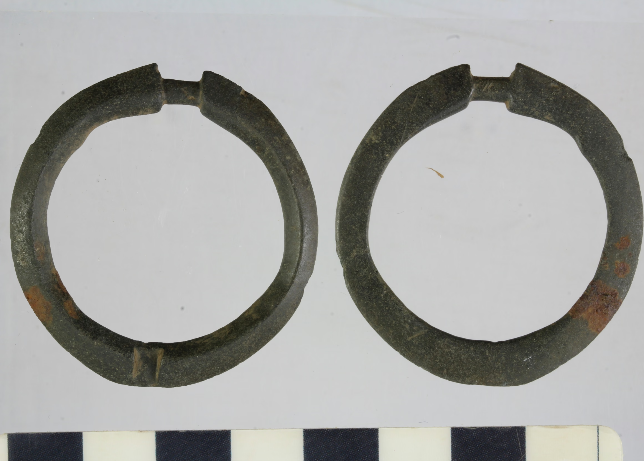
To be honest, this item stayed in my collection for a long time before I finally brought it in to the Finds Liaison Officer. To my untrained eye, it looked a lot like a simple loop from a modern horse harness—the kind of scrap metal that is both too common and too new to report. But I just had a feeling about it. It was that particular patina; it just looked like it held centuries of history. Fortunately, I remembered exactly where I was on the field when I found it, so I packed it into a literal shoebox with other finds and trundled off to the museum. I seriously thought I’d get it back with a note attached: ‘Not Recorded: TOO Modern.’ So imagine my delight to find out it was in fact over 600 years old!

Recorded as WILT-728A87, the FLO confirmed this “simple loop” is actually an incomplete medieval copper-alloy annular (ring) brooch dating between c. AD 1270 and 1350—the era of Edward I and II and the dawn of the Hundred Years’ War.

In the High Middle Ages, long before buttons became standard, wealthy nobles wore silver or gold brooches inlaid with jewels, while everyday folk relied on plain, copper-alloy examples like this one. The reference cited in the finds database record—Dress Accessories c. 1150–c. 1450 from the Museum of London —shows that undecorated, bevelled brooches of this exact size were the absolute workhorses of medieval clothing. Used by men and women alike, these simple circular frames held tunics, cloaks, and chemises together at the neck or shoulder.

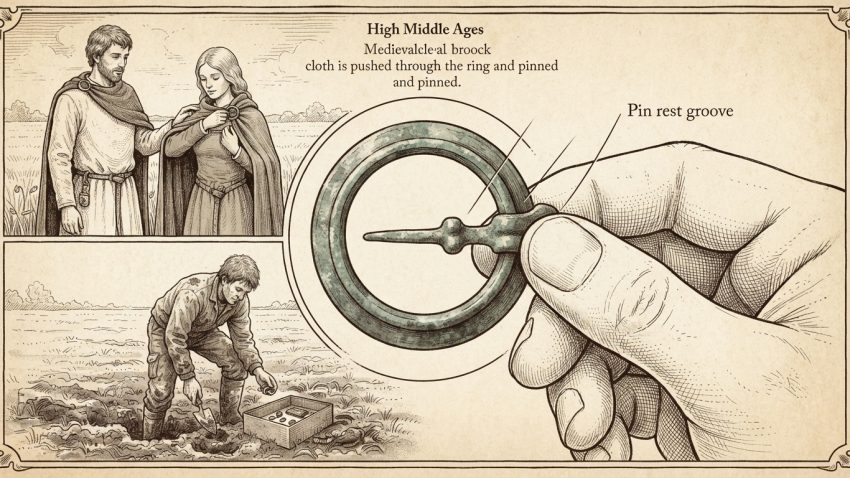
To wear one, a person gathered a lump of cloth up through the center of the ring, pushed the pin point through the fabric, and pulled the ring back down so the pin rested flat against the frame, keeping the garment secured under tension without tearing it.

Though missing its original pin—which would have been a thin copper-alloy wire that snapped, or an iron pin that rusted away in the soil—my brooch still sports that distinct, smooth grey-green surface patina that speaks of over seven centuries in the ground. The outer edge is subtly bevelled, angling down to a flat inner surface. On one side, the frame narrows into a 5.9mm pin constriction where the pin hinge once rested. Directly across from it lies a small, rectangular groove—the pin rest designed to catch the tip under tension.

Losing a brooch in a 13th- or 14th-century field meant a loose tunic or a mantle coming undone on a cold Wiltshire morning. Holding it now, I’m glad I trusted my gut—what looked like a scrap harness ring turned out to be a genuine piece of medieval everyday life, its story preserved in the soil for over 650 years.

WILT042E25

Find No. 40: Fit for a Bishop

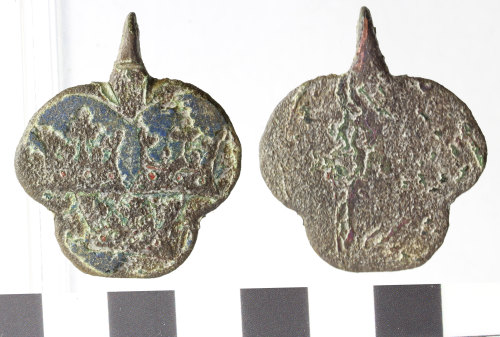
In a previous entry, I mentioned how easy it is to mistake small metal hooks for horse harness fittings. But this next recovery leaves no room for guesswork: a medieval enamel-inlaid harness pendant, logged under PAS reference WILT-042E25. Measuring 40mm long and weighing under ten grams, this ornate copper-alloy piece dates from between AD 1200 and 1400, spanning the high Middle Ages.

I remember finding this little item as if it were yesterday. It was the first thing I’d dug that matched the romanticised image I’d always held of the medieval period. As I turned it over in my gloved hand, boyhood images of King Arthur and questing knights came racing through my mind.

Harness pendants were decorative heraldic ornaments suspended from a horse’s breastplate, martingale, or bridle. As the horse trotted along, these small tags swung and flashed in the sunlight,  advertising the status, allegiance, or noble lineage of the rider.

Despite spending hundreds of years buried in local soil, this pendant is complete and retains fascinating details. Shaped in a decorative trefoil—a three-lobed form—it features a transverse mounting loop projecting from the top. Its surface is inlaid with vibrant enamel depicting three golden crowns set against a bright blue field. On closer inspection, each crown’s band is set with three tiny red enamel pellets representing embedded jewels.

In the language of heraldry, “three crowns on a blue field” (azure, three crowns or) is a deeply iconic coat of arms. While similar pendants with red backgrounds were associated with the Bishop of Ely, the blue field on this piece points toward the famous Abbey of Bury St Edmunds—dedicated to Saint Edmund, the martyred 9th-century King of East Anglia.

Whether belonging to an official envoy, a wealthy pilgrim, or a knightly traveller, it is easy to picture an ecclesiastical entourage riding the road between Winchester, Clarendon Palace, and Salisbury—perhaps stopping in West Grimstead to witness the blessing of its newly expanded 13th-century church around the time its first recorded rector, Ricardus Brione, took his post in 1294. As the rider’s horse trotted along the track, its harness jingling with heraldic brass, the suspension loop snapped, dropping this vibrant piece of medieval pageantry into the village mud right along the path to St John’s.

This small harness decoration is one of my top 5 finds, —a vibrant, colourful link directly to the high medieval church and the nobility who once passed through the Dun Valley.

Find 22: The Master’s Mark
Find 16: The Great Recoinage of William III