The air in the Dun Valley today was crisp, carrying that specific, heavy scent of turned earth and early blossoms that only a Wiltshire spring can provide. A pale, watery sun struggled to burn through a ceiling of grey cloud, casting a soft, shadowless light over the pasture. To me it was the perfect weather for detecting. Without the glare of a too bright summer day or the biting cold of a spring frost, there is a quiet clarity to the landscape that allows for total concentration. It was an added treat to a morning of quiet persistence, where the only sound random low-frequency hum of the detector and the occasional, mocking caw of a crow overhead. The peace was suddenly broken by a jarring, authoritative signal in my headphones—the kind of loud, brassy shout that suggests something either very large or very near the surface. As it turned out, it was both.
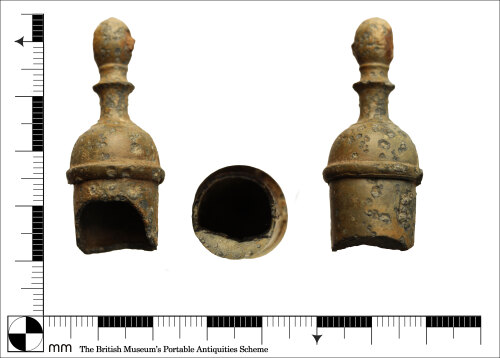
What emerged from just beneath the thatch of the meadow was an incomplete cast copper alloy whistle, dating from the mid-eighteenth to the late nineteenth century. Though it has lost its mouthpiece, the remaining fragment reveals a high degree of craftsmanship. Rather than a simple, utilitarian loop for a string, the apex features an elegantly turned baluster finial. This decorative handle suggests the whistle was a piece of some prestige, perhaps once fitted into a larger handle of bone or fine wood. You can still see the traces of the original casting seams running down its cylindrical body, leading to a perfectly circular sound hole. It is a sturdy, well-engineered object, designed to produce a note sharp enough to carry across these very fields, regardless of the wind or the clamour of a hunt.
There is a particular melancholy in finding a whistle that can no longer sound. It is a truncated instrument, a silent signal that has outlived both its purpose and its person. We know that hunting parties have roamed these hills for centuries, and the quality of this piece strongly suggests it was the tool of a Master of Hounds. As I stood in the quiet of the field, turning the broken whistle in my hand, I could picture the scene: a crisp morning much like this one, the horses stamping in the mud, the master of the hounds reaching for his instrument to command a pack of baying hounds. A short burst on the whistle and they’re off! Perhaps, during the excitement of the chase, the whistle fell and was trodden by an anxious rider. In an instant of high-speed drama, the broken instrument became a useless fragment, left behind and forgotten as the hunt thundered across ‘the Grimmers.’







You must be logged in to post a comment.