The still air over the Wiltshire plains was pleasant for late February, yet the gusts of wind from the southwest still held that sharp, late-winter bite. With the sun a welcome warmth on my back, I searched across the rolling hills in a village just south of Salisbury. The flint-strewn ground looked stark and cropped short by nervous sheep who tend to give me a wide berth, especially during lambing season.
My permission stands on one of the highest points in the area, certainly not as high as Pepperbox Hill, but from this one location I can see the the undulating, hazy edges of the New Forest in one direction and the distant, reassuring spire of Salisbury Cathedral in the other. I started thinking about that view 600 years earlier before the cathedral’s spire dominated the landscape and I almost missed the clear, bell-like tone from the detector. It was a high-pitched, clean signal that immediately felt different—an absolute purity among the usual grunts and chatter. I backed up and ran the coil over the spot again, confirming the precise location.
The Moment of Discovery
Retrieving a tiny target amongst this dense flint and rock is often a frustrating task, but the distinct signal brought a calm, careful focus. On such ground, a shovel is useless; a stout digging tool and patience are the best friends one can have. What eventually emerged from the cold, dark earth gave me pause: a small, rectangular fragment of worked gold. It possessed that unmistakable, deep lustre—the shade of yellow only antiquity imparts.
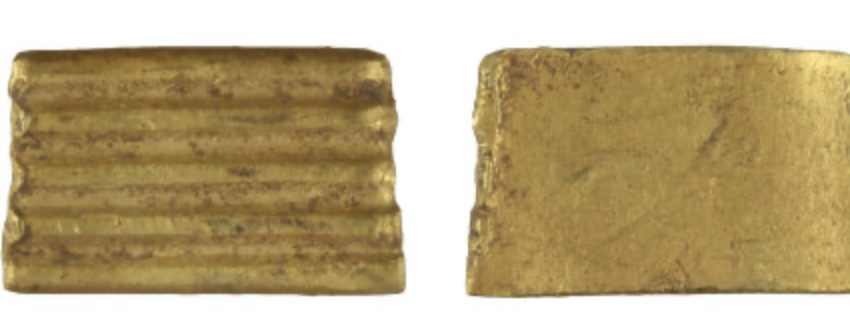
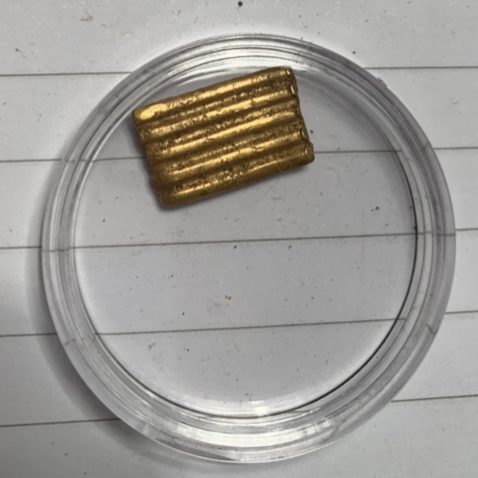
This was clearly not a natural nugget, but something crafted by human hands, its original purpose veiled by the centuries. It was truncated at both ends, the breaks looking like deliberate, ancient cuts, and I judged it to weigh barely three grams. This small weight belies its immense historical significance. (A clear, focused photograph of the object is essential here, capturing its scale and colour.)
I slipped off my gloves, the cold momentarily forgotten, to properly appreciate the piece. Turning it carefully in my palm, I examined its artistry. It was crafted with five delicate, parallel ribs, and along the sides of each rib runs a beautifully incised zig-zag pattern. The reverse, in quiet contrast, remained plain and smooth. This level of miniature craftsmanship, scaled down to such a small fragment, speaks volumes about the value—both material and cultural—that was placed upon it.
The Historical Footprint and Personal Meaning
Holding this tiny piece of gold, feeling its surprising weight, my mind immediately travelled back to the Bronze Age (roughly 2,400–800 BC). The specific style of decoration strongly resonated with images I’ve seen in archaeological reports. A consultation with the Portable Antiquities Scheme (PAS) database quickly affirmed this initial instinct, revealing comparable finds of ribbed gold strips identified as Bronze Age ribbons.
These fragments are often interpreted by archaeologists as pieces of fine hair ornaments or elaborate clothing decorations. Yet, the truncated ends are particularly compelling. In the Bronze Age, gold was often cut to precise weights for exchange, sometimes called “ring money” or “segmental currency.” I pictured the original owner, some four millennia gone, carefully snipping this segment from a larger piece—perhaps a bracelet or torc—to purchase a beast or some precious commodity. How gutted they must have been to lose this valuable commodity, perhaps sinking into the mud, its purpose unfulfilled.
The quiet loss of that ancient person stands in stark contrast to the profound elation I felt in that moment, a feeling that cemented my own journey as a true detectorist. The unspoken tradition among detectorists suggests a celebratory ‘gold dance,’ yet the overwhelming feeling here, in the quiet solitude of the field, was one of profound respect and stewardship. I allowed myself a small, discreet jig once I was safely off the exposed side of the hill, satisfying the superstition. Tradition noted, I headed back to the farmhouse to present my find to the astonished landowner, ensuring the correct reporting procedure was initiated immediately. This small, magnificent object is a tangible, direct link to an individual from three millennia ago. It is a humbling honour to be the person who brought their story back into the light.
Rights Holder: Salisbury and South Wiltshire Museum






You must be logged in to post a comment.