It really is amazing how a simple piece of lead pulled out of a muddy field can instantly connect our modern, everyday routines—like standing on a clinic scale—straight back through the Roman Empire to Archimedes, the father of modern physics. Every time I go to the doctor’s office for a checkup, I’m weighed and while waiting for the cantilevering to stop I think about the mechanics of the scale they use. There is no massive, 150-pound iron weight (or two!) involved. Instead, the nurse slides a small metal weight along a notched beam until it balances horizontally. By using leverage, that tiny weight can balance a person’s entire body weight. This is time-tested technology, as evidenced by a small, heavy piece of grey metal I rescued from the Dun valley soil last month.
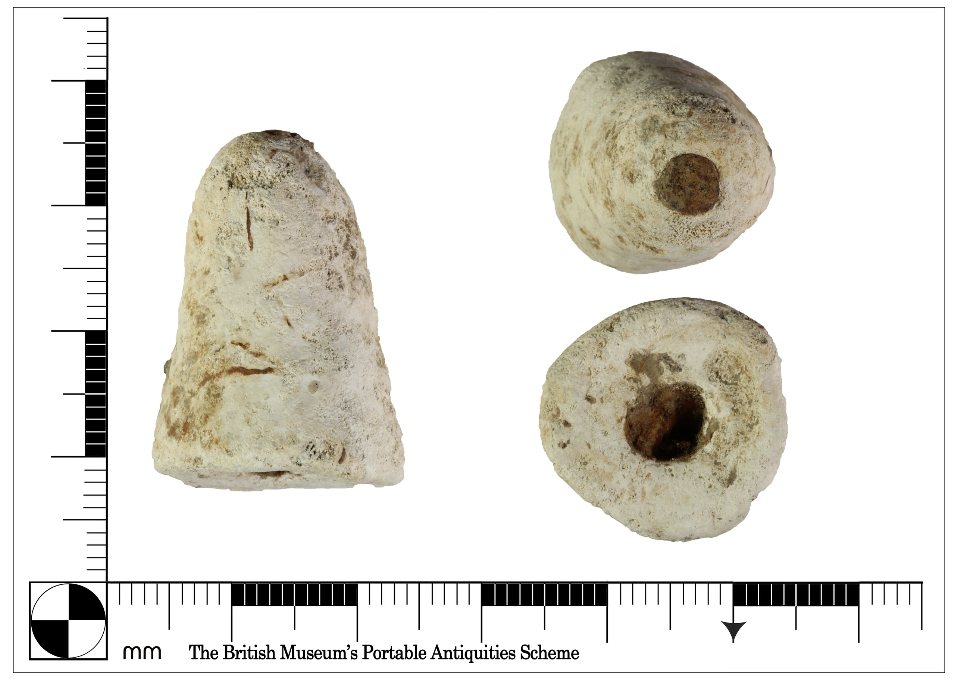
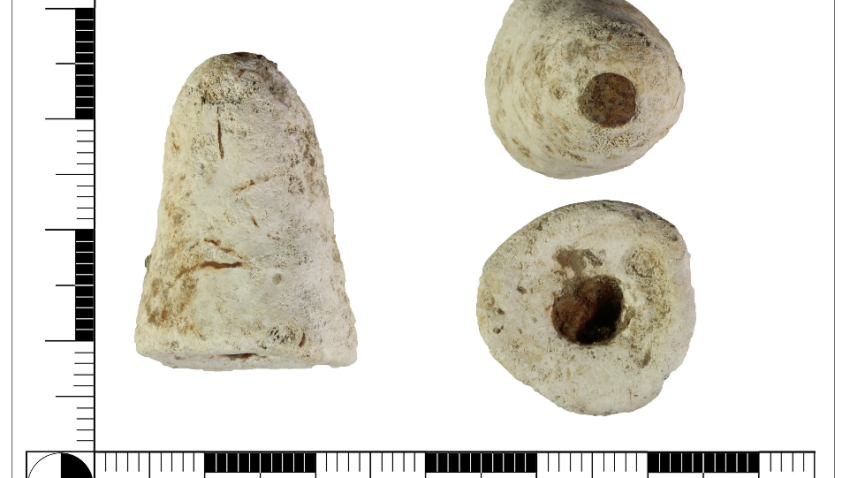
Recorded by the Finds Liaison Officer as an incomplete conical lead steelyard weight (PAS ID: WILT-0401DC), this simple object dates anywhere from the early Roman period right through to the Middle Ages (c. AD 43–1350). Standing just under 30 mm tall, it features a classic conical shape, cast with a hole running through its center. Inside that piercing at both top and bottom, you can still see the iron rust stubs of the original suspension loop that once held it to a metal beam.
Carrying a heavy set of fixed weights for traditional balance scales was impractical for traveling traders and merchants. Instead, they used a steelyard scale (statera), which relied on a single movable weight and a notched beam.
While these are often called “Roman balances,” the Romans actually adopted the technology from the Greeks, who developed it around the 4th to 3rd century BC using Archimedes’ principles of levers. Recognizing how useful these lightweight scales were for trade and the military, the Romans standardized the design and it spread to the ends of the Empire—which is why so many of these weights are found all over Britain.
Despite centuries of agricultural wear and the loss of its iron hanging loop, this weight sits at 54.46 grams.
In the Roman measurement system, the standard pound (libra) was divided into 12 ounces (uncia), with a single uncia weighing roughly 27.41 grams. Multiply that by two, and you get 54.82 grams—meaning this weight, even today, sits less than 1% off an exact 2 Roman Ounces (Sextans / 2 Unciae). The fraction of a gram missing is easily accounted for by the iron wire that rusted away inside the central core.
Whether used by a Romano-British trader or a medieval merchant carrying on an age-old tradition, this simple piece of lead was a crucial tool of everyday commerce, turning Greek lever mechanics into fair trade across Europe, and to our local fields.

 Carrying a heavy set of fixed weights for traditional balance scales was impractical for traveling traders and merchants. Instead, they used a steelyard scale (statera), which relied on a single movable weight and a notched beam.