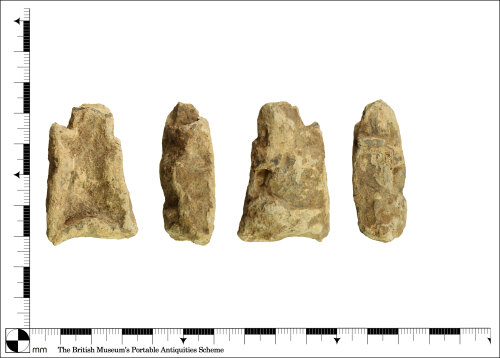
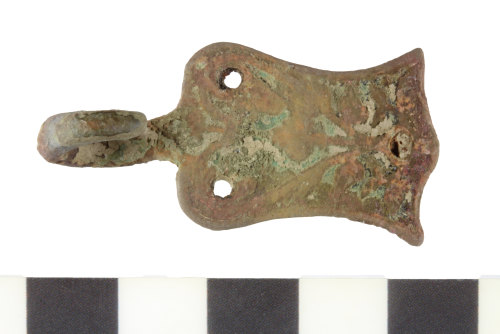
When I documented a medieval clasp in a previous entry, I made a brief passing reference to another favourite piece from my collection—a post-medieval hooked strap fitting. Measuring 44mm long and weighing just under seven grams, this copper-alloy piece (logged under PAS reference WILT-336B57) dates from between AD 1550 and 1700, spanning the dramatic Tudor and Stuart eras.
I found this item in the very same West Grimstead field that yielded a rich assortment of Tudor and Stuart discoveries—a dress fastener, bag seal, star pendant, leather palm guard, lead beads, and a lead cloth seal originating all the way from Augsburg, Germany. I don’t often stop to picture local life 600 years ago, but this variety suggests a landscape bustling with all classes of people. In the 1500s, West Grimstead was a quiet parish of just 200 souls, ruled by lords descended from the de Grimstede line. The only landmark I would recognize today is St John’s Church, already two centuries old back then. Yet lords, soldiers, merchants, and farmhands all passed through these pastures—and St John’s was the one constant every single one of them would have walked past.
Despite long sleep in the Wiltshire soil, the fitting is complete and survived with crisp detail. It features an elegantly shaped body with concave sides, a flaring “fish-tail” attachment end, and an integral forward-facing hook projecting from its rounded tip. The surface is decorated with a raised foliate motif—a classic Tudor floral design—and tucked into the far end is the iron-stained remnant of its original rivet.
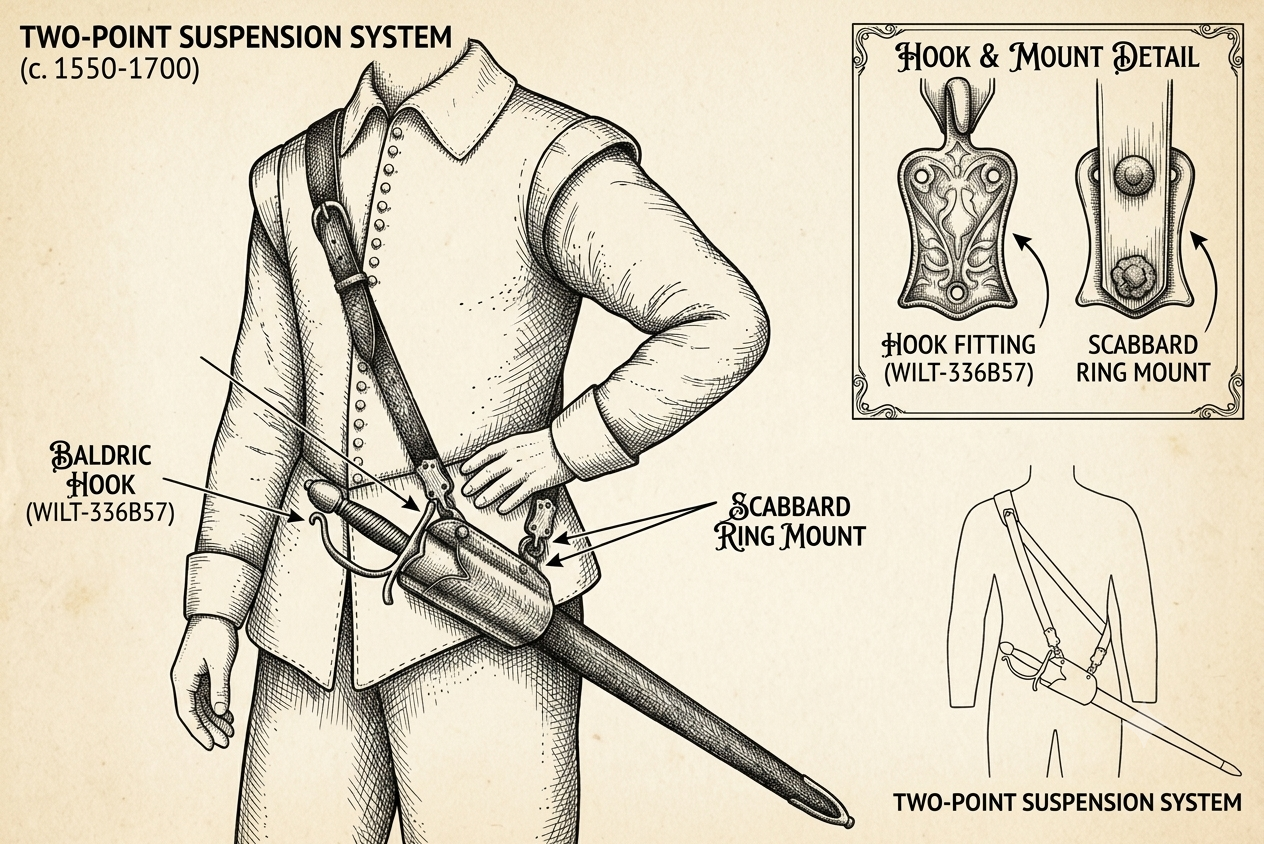
While small hooks like this can easily be mistaken for horse harness fittings, experts point toward a far more exciting function: a hanger fitting from a post-medieval sword belt or baldric.
During the 16th and 17th centuries, gentlemen and soldiers wore heavy rapiers suspended from leather shoulder belts. Rather than permanently buckling the heavy weapon to the leather harness, craftsmen used clever hooked fittings like this one. The plate was riveted securely to the leather strap, allowing the wearer to quickly hook and unhook their sword scabbard when stepping indoors or mounting a horse. The single hook I found was almost certainly one half of a matching pair (or trio) that together kept a rapier balanced right at a gentleman’s side! It is easy to picture a Tudor traveller or Civil War soldier riding across those West Grimstead pastures, the weight of their scabbard bouncing against this very hook. Over time, the strain sheared the iron rivet, leaving this ornate bit of military hardware behind in the dirt.
Having been recorded by the museum and returned to my care, it sits on my shelf today as a brilliant reminder of the history woven into our village fields—proving once again that every find (or finds in this case) tells a story!

 Having been recorded by the museum and returned to my care, it sits on my shelf today as a brilliant reminder of the history woven into our village fields—proving once again that every find (or finds in this case) tells a story!