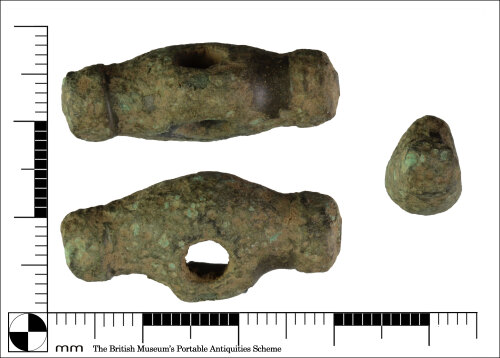
Every now and then, I find an object that straddles the fence between two historical epochs. This tiny copper-alloy toggle is exactly that—a piece of personal equipment dating from the Late Iron Age to the Early Roman period (c. 100 BC – AD 100).
I discovered it in a field that has always been a bit noisy on the detector. It’s not far from a main road thru the village, and I find the odd soda can or bottle top on each visit. On this day, I was scanning ‘on the level’ where the hillside creeps slowly down toward the neighbours property. In admist the scratchy tones from aluminium and modern scrap was a small target with a repeatable strong signal.
The Industry of the Valley
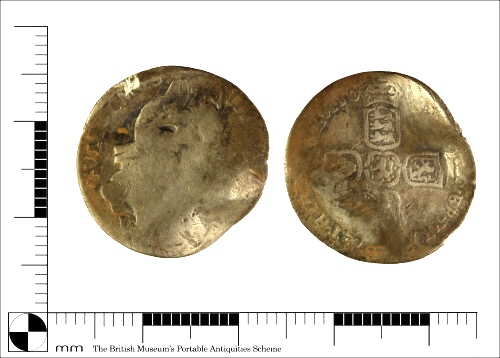
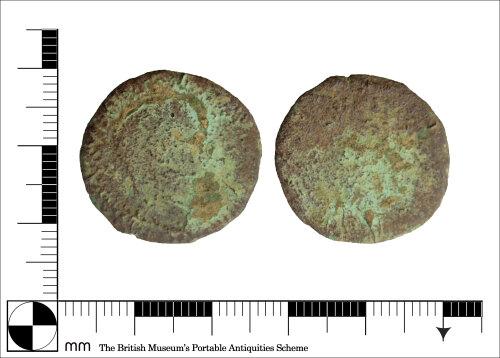
The context of this field is starting to come into focus. Just beyond the boundary of my permission lies a known Roman brickworks, and here on my side of the fence is a large sand pit. I’ve already recovered three Roman coins from the area around the pit, which makes sense; the sand would have been an essential raw material for the nearby kilns.
Perhaps most interesting is the evidence of terracing nearby. It appears the land was deliberately modified, likely to create a more level path across the slope. This “engineered” landscape would have allowed carts to move the heavy sand toward the brickworks with far less effort than the natural gradient would allow. Finding this toggle near the sand pit and these man-made terraces suggests it wasn’t just dropped by a traveler, but perhaps by someone involved in the logistical life of the valley, working the very paths they had helped to level.
The Anatomy of the Toggle
Formally recorded as WILT-04334D, the find is a complete copper alloy toggle measuring 26.3mm in length and weighing 9.43g. The object is remarkably complete, though its surface tells the story of two millennia in the soil. A semi-circular loop extends from the top of the cylinder, enclosing a circular perforation; notably, the hoop of this loop is D-shaped in section. The ends of the cylinder are thickened, giving the appearance of deliberate end-caps. While the surface is now roughened, small sections of a mid-green patina still cling to the metal.
Rights Holder: The Portable Antiquities Scheme
The presence of this toggle on the same farm as the Roman coins and the sand pit suggests it belonged to someone integrated into the valley’s working life. It wouldn’t be too fantastical to imagine a metalworker sitting here, repairing the harnesses of the carts used to haul sand along those terraces, or a local a Roman official adapting to the local landscape. And while it wouldn’t seem out of place on a modern cloak or jacket, it is a small but vital bridge to the Iron Age, found at the very heart of the valley’s ancient industrial life—a reminder that while our modern eyes see a field suitable only for grazing sheep, it was once the centre of great industry.






You must be logged in to post a comment.