It was a warm, early summer afternoon, the air still and heavy with the scent of freshly cut hay from a neighbouring field. The sky over the rolling hills of Winterslow was a vast, unbroken dome of blue, and the flinty soil underfoot felt firm and dry. In a nearby paddock were three horses—Buddy, Star, and Daisy. I noticed that Buddy was particularly attuned to the high-pitched beep of my pinpointer, and he watched from the fence line with a curiosity as keen as any of the dog walkers passing through. I was working a seldom visited field, the silence broken only by the players on a distant football pitch and Buddy’s occasional soft snort of interest.
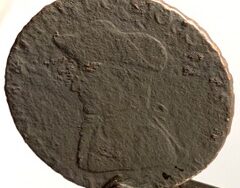
There’s a certain magic to the sound a good signal makes, but equally, a different kind of anticipation when it’s a deep, stubborn noise that suggests something entirely unexpected. On this occasion, a hesitant but persistent signal led me to unearth something humble and remarkably worn: a token.
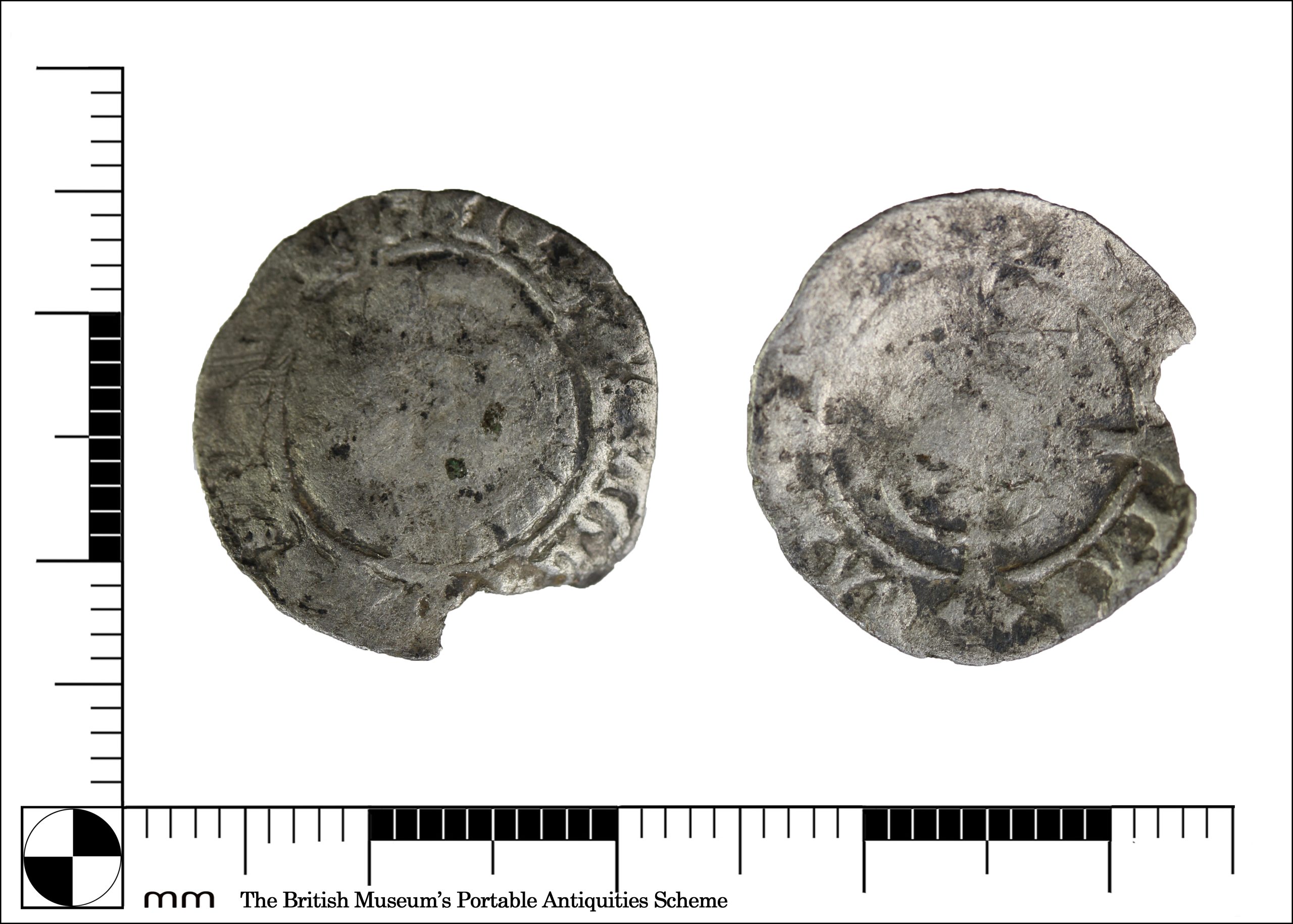
Unlike coins, which were designed for longevity, this token was a bit more ephemeral—a hapenny payable by grocer and tea merchant John Stride in the coastal town of Emsworth. The token’s lack of formal stature, combined with its long slumber in the earth, had rendered its details nearly illegible. But a quiet evening of gentle cleaning and research revealed its story, and what a story it was.
It commemorates a momentous event in British history: the Glorious First of June of 1794, a naval battle in the Atlantic where Admiral Howe’s fleet dealt a significant blow to the French. It was an iconic moment of national pride, and this small piece of copper—with its image of the Admiral on one side and a defiant Britannia on the reverse—is a physical echo of that time.
It’s a find like this that truly brings the past to life. I found myself thinking not just of the battle, but of the individual who might have carried this token. A sailor returning home from the war? A merchant, perhaps, who traded between various ports and Salisbury? This little disc travelled from a coastal town many miles away to end up, worn and forgotten, in this quiet Wiltshire field. It’s a powerful reminder that history isn’t just made by grand figures and armies, but by the everyday lives of ordinary people, and their journeys.
And so, another important entry is made in our growing collection. While it’s not a Roman denarius or a Saxon brooch, this humble token is a vital find, proving once more that every find tells a story!
The find has yet to be assigned a Unique ID, but it will count towards my goal of 100 finds on the British Museum’s Portable Antiquities Scheme database: finds.org.uk.
Key Details:
* Object Type: Emsworth halfpenny token
* Historical Context: Commemorating Admiral of the Fleet Richard Howe (1726-1799) and the Glorious First of June, 1794.
* Obverse: Bust of Admiral Howe in a tie-wig, uniform and cocked hat. Legend: ‘EARL HOWE & THE GLORIOUS FIRST OF JUNE’.
* Reverse: Britannia seated, with shield, holding an olive branch and spear. Legend: ‘RULE BRITANNIA’. Exergue: ‘1795’.
* Edge Inscription: ‘EMSWORTH HALFPENNY PAYABLE BY IOHN STRIDE’.