The most profound moments in this hobby often aren’t about glinting gold or silver, but about the quiet conversation we have with the past. The spring light in February can be deceptive—warm on the face, cold on the back, but hinting at the promise of warmer days. In a hilly pasture, with a long view over the Wiltshire countryside, the spire of Salisbury Cathedral a delicate needle on the horizon, one can’t help but feel the immense weight of time. I am constantly reminded of just how long Wiltshire has been populated.
It was on one such uncharacteristically warm afternoon that I was walking, the steady, rhythmic sweep of the detector a calming metronome to my thoughts. Keeping it ‘low and slow’ as the boffins of metal detecting always advise. Patience is a valuable tool, and though there weren’t many finds so far, the pleasant weather and the distance from the highway and even the farmhouse had put me in a mood that didn’t mind how far apart the targets were.
And then came a signal that felt different—high and clear and resonant, a bell like tone that promised something more substantial than a nail or aluminium. Eagerly I began to clear the soil, which chose to slow me down by being full of flint and rocks that needed freeing by hand. And I was glad for the reminder to take care when I exposed the distinctive patina of long buried copper alloy. A shade of green like nothing else. I knew I had found something Old. I admit I got a bit excited, not that I had any idea what I’d dug up at this point, but with the simple thrill of discovery, of being the first person in millennia to see this object.
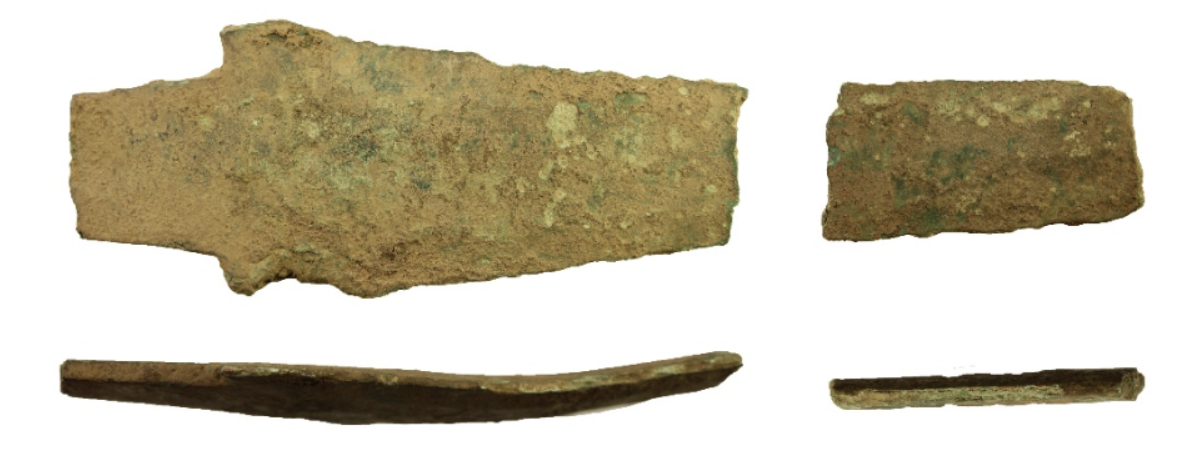
The find, as it turned out, was a short dagger blade, split into two pieces. One fragment was a beautiful section of the blade, featuring two delicate, raised ribs, their form still visible after all these years. The other was a smaller section of the tang, the part that would have been set into a wooden or bone handle. It was an almost complete puzzle, right there in the soil, minus only the very tip of the dagger. My mind whirred at that instant, just thinking about the absolute gulf of time between the hands that buried it and mine as I photographed it and then carefully placed it in a small plastic case in my backpack. I sent the photo to the FLO (Finds Liaison Officer) at Salisbury Museum, and they were immediately interested. I was able to turn it in to them less than a week later. Then came the long wait to hear what they thought of it. I gave the location a wide berth to avoid further disturbing the site. My thought was that I might have discovered some grave goods and that more experienced eyes might need to examine the location as I found it.
After examination by the wonderful teams at Salisbury Museum, Wiltshire County, and finally the British Museum, the true story of the dagger began to unfold. It was identified as a Late Bronze Age piece, dating to somewhere between 1150-800 BC. But what made it truly special was its condition. The experts confirmed that the blade was not broken by a plough or the passage of time, but that the bending and transverse break were clear evidence of deliberate, ceremonial destruction, likely done just before it was laid into the ground. I was relieved to find that I hadn’t damaged it myself, but why would someone break such a fine tool? Their research suggests two compelling possibilities: a practical act, perhaps breaking the blade to be recycled into a new implement, or it was a more symbolic one, a gesture to bind two communities together or to mark a significant moment. Like the breaking of arrows to signify the end of hostilities. This gesture may explain why the actual tip of the dagger was not present, or lost nearby. Prior to finding the dagger the closest find to it was a long forgotten mole trap.
These theories–for we will never truly know–give so much more weight to the value of the find itself. I look at this dagger, and not just think about the 3000 years it lay on a hillside near Salisbury, but at the intentional action of the person who broke it. It is a tangible link to a world where objects were imbued with deep meaning, this dagger is scarcely more than two wedge-shaped pieces of copper today, but back then, they must have represented something quite significant. And its destruction carried as much weight as its creation. I am humbled by the nature of my hobby. This dagger, though not made of gold, is considered a hoard and is of historical value, showing that some of the greatest treasures we can find are not shiny but are instead rich with the quiet resonance of a story waiting to be told.
(Rights Holder: The Portable Antiquities Scheme. Used with permission under Creative Commons.)
A link to the British Museum Finds database for this item is here.



You must be logged in to post a comment.