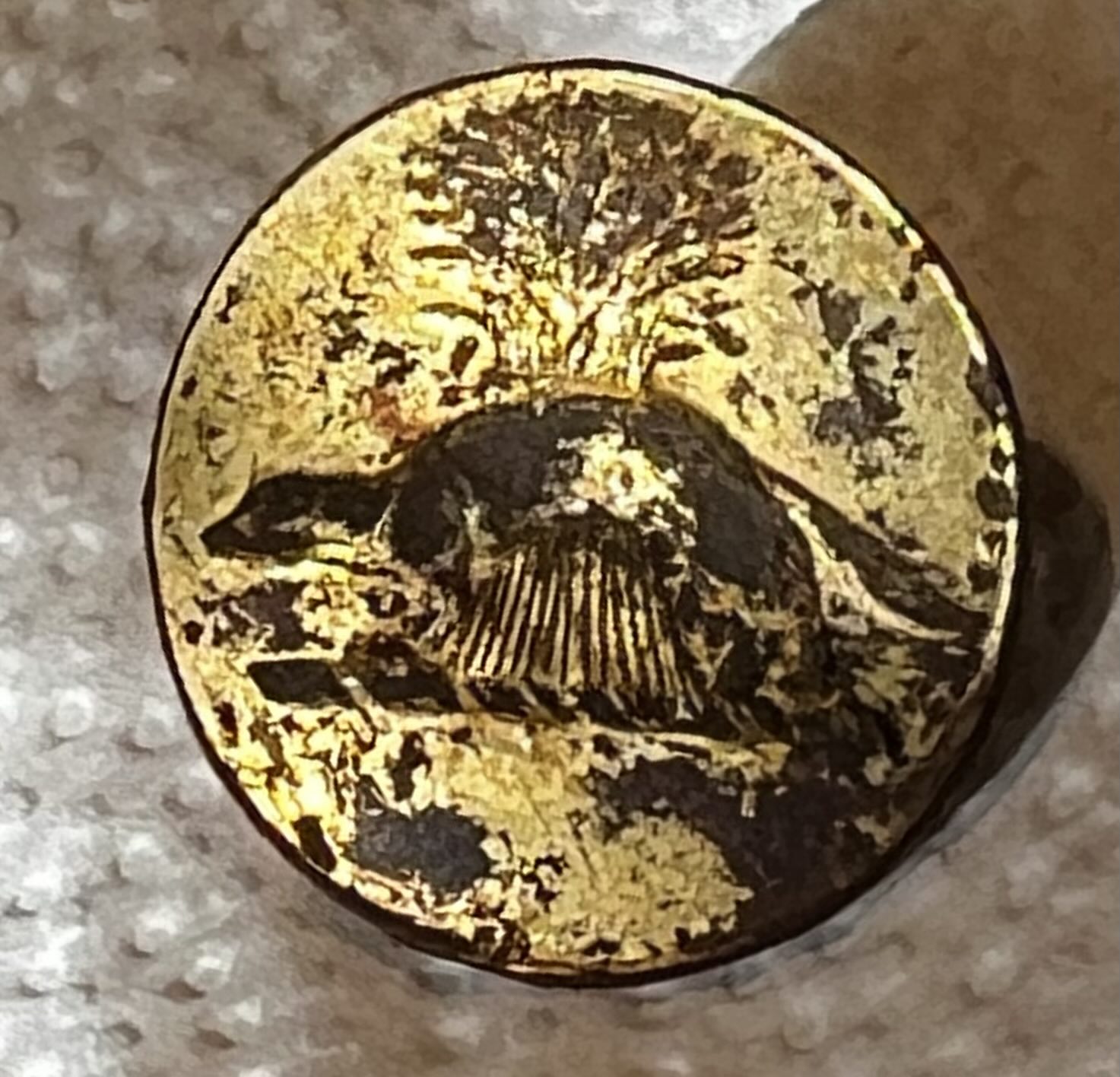
Object: Two High-Status Livery Buttons Material: Fire-Gilt (Gold-Plated) Brass Manufacturer: Standish & Co., 48 Mount Street, London (Mayfair) Date: Circa 1870–1890 (Late Victorian) Iconography: An Otter Passant on a torse (braided cord) with a Garb (wheatsheaf) behind it.
At first I was surprised to find not one, but two gilded buttons in the same hole. Okay, to be honest, my first thought was “Woo Hoo! Gold!” Then I started wondering why and how they came to be there? All I knew about otters was that they had been hunted to near extinction, and I suspected these buttons were perhaps a hunting prize or similar.
However, their depiction of “An Otter Passant on a torse with a Garb (wheatsheaf) behind it” makes it more likely these are livery buttons from the Luttrell or possibly Coleridge families, who have similar designs in their family crest.
But finding two together seemed odd. It’s unlikely a livery coat was considered “shoddy” and buried in a field with two shiny buttons still intact. They were worth money! A bit more research suggested an even darker scenario for why they were together in the sandy soil near Windwhistle Lane.
The only reason to leave such valuable items attached was fear. Before germ theory was fully understood, the prevailing belief in “miasma” meant that fabrics were viewed as dangerous vessels for disease. Consequently, when a servant fell ill, a household’s standard response was the immediate disposal of their belongings. A porous, heavy wool livery coat would have been seen as a contaminated death trap—one that even the most destitute villager wouldn’t dare salvage. Instead, the garment was likely shoveled into a pit, buttons and all, and interred in the aerated sandy soil near Grimstead Road. Over the next century and a half, the wool vanished into the earth, leaving behind only two glints of gold and the crisp, haunting imagery of the otter and the wheatsheaf.
The backmark “Standish & Co, Mount Street” identifies the coat as a premium garment from a high-society London tailor. The presence of the Garb (wheatsheaf) is a specific heraldic difference often used by the Luttrell or Coleridge families , both of whom had ties to Wiltshire and London social circles.
In the 19th century, sand was often used for “sanitary burials” because it drained well and was thought to filter the “bad air” of a diseased object better than heavy clay. More than likely, I have found the final resting place of a livery coat belonging to a footman who fell ill while his masters were visiting the Longford/Grimstead area. It is a hauntingly beautiful find that turns a piece of metal into a story of a specific person, a specific tailor, and a specific moment in West Grimstead’s past. One day I must return to see if other items, such as belt buckles or more buttons, await rediscovery after their century and a half’s slumber.






You must be logged in to post a comment.