Rights Holder: Salisbury and South Wiltshire Museum (WILT-DD69F4)
Metal detecting is, by definition, a search for the conductive. We listen for the hum of copper, the scream of silver, or the dull grunt of iron. But sometimes, the most profound finds aren’t made with the ears, but with the eyes.
My detecting journey began at a tiny stream that defines the border between two fields, situated several hundred yards downhill from where the Bronze Age gold fragment was discovered. From the water’s edge, it’s quite steep going to get up to the next level bit, so I was taking my time, scanning as I climbed.I caught a signal that turned out to be nothing more than a discarded foil wrapper, but while I was down on my knees freeing it from the topsoil, I noticed quite a few sharpish bits of flint along the stream bed.
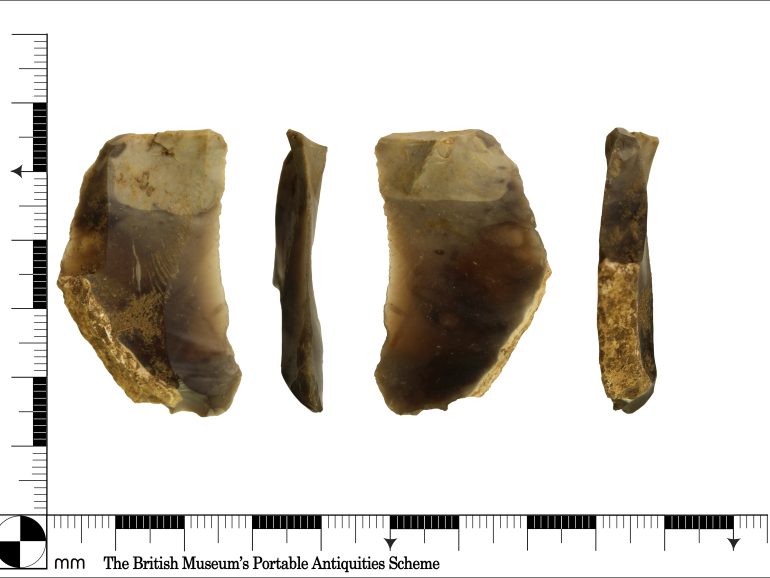
I had my doubts that they were anything other than shards formed by centuries of frost and thaw, but one seemed sharper, and the edge felt a bit more intentionally “worked” than its neighbour’s. Among the natural stones, this flash of something glassy and dark stood out. It wasn’t metal, but it was undoubtedly a tool. What I had found was a piece of “debitage”—a flint flake struck from a core by human hands thousands of years before the first coin was ever minted in Britain.
Analysis and Context: The Neolithic Blade
The museum has identified this find as a secondary blade, likely dating to the Early Neolithic period (c. 4000–3300 BC). This makes it, by a margin of a 1000 years or so, the oldest object in my collection.
Material: The flint is a beautiful, translucent dark grey, punctuated by a large, pale grey inclusion that gives it a unique character.
The Maker’s Mark: Experts noted a “low bulb of percussion,” suggesting it was struck using a soft hammer (likely antler or wood) rather than a stone. There is a discernible striking platform where the ancient ‘knapper’ placed their blow.
Form and Function: It is a secondary blade, meaning some of the “cortex” (the rough, outer skin of the original flint nodule) remains on the outer face near the tip. The tip of the blade also shows signs of retouching—fine, deliberate flaking to sharpen or shape the edge for use.
At 41.8mm long and weighing just 7.92g, it is a lightweight but incredibly sharp testament to prehistoric technology.
Reflections: A Merging of Hobbies
When this flint was struck, the people living in the Avon Valley were among the first farmers in Britain, transitioning away from the hunter-gatherer lifestyle of the Mesolithic. Finding it near the stream bed makes perfect sense; water sources were the lifeblood of these early settlements, and the steep banks may have protected this site from the plough for centuries.
It’s a strange thought: my detector found only trash as I walked over this spot and now without trying, my searching has now expanded into the non-metallic. I was a keen rockhound as a boy, and somehow that early passion for stones has merged with my current hobby to make the whole experience more pleasurable. It serves as a reminder that as much as I rely on technology to find the past, there is no substitute for keeping one’s eyes on the ground.






You must be logged in to post a comment.