
Rights Holder: The Portable Antiquities Scheme
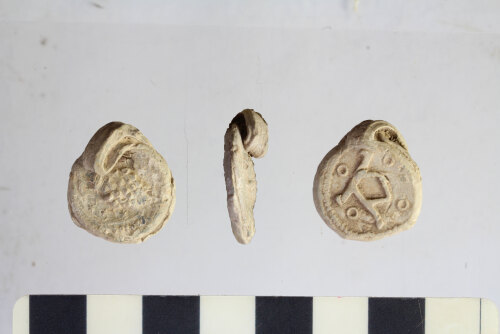
I decided to branch out from my usual fields and head toward the River Test, kinda near the old Horsebridge station. The area is stunning, all water meadows and ancient crossings, though the heavy, flinty ground makes scanning a challenge. Tracking a low, solid tone on the detector just six inches down, I dug up what looked like a tiny lead token. It turned out to be a complete, dark-grey patinated lead cloth-seal dating between AD 1500 and 1650. Measuring 19.4 millimetres in diameter, 4.1 millimetres thick, and weighing 10.15 grams, it comprises two circular discs joined by a narrow strip that was folded shut. On its front disc sits an incomplete uppercase letter A within a cusped border surrounded by four annulets, while the reverse carries the Zirbelnuss—a stylized pine cone above a horizontal band containing six pellets—marking it directly as an official import from Augsburg, Germany.
In the mid-16th century, the lead seal was a legal requirement for the export of fustian—a heavy-duty fabric of cotton and linen. The seal acted as a guarantee of quality and proof that the required taxes had been paid to the Augsburg Weaver’s Guild. Finding such a seal in Stockbridge provides evidence of the direct penetration of South German industrial goods into the English rural economy.
Moving a multi-ton shipment of fabric across late-medieval Europe was a monumental feat of bulk logistics. A standard consignment of a hundred bales exceeded thirty tons, shifting the pace of trade from nimble packhorses to heavy ox-wains that crawled along at two miles per hour. Navigating river barges down the Rhine, cranes at Antwerp, and shipping lanes across the Solent to Southampton added days at every transshipment point. Unpaved roads turned to thick clay in the wet, meaning missing a late-summer window could stall a shipment in a warehouse for half a year under seasonal wagon bans.
It doesn’t escape my overactive imagination that this seal literally ‘fell off the back of a wagon.’ Maybe several people chipped in on a single bale and it was divided up in this admitedly odd and quiet location between Stockbridge and the Leckford Estate, but maybe the shipment , after its long journey, fell victim to rogues just here, beyond the safety of the churchyard and just out of site of the Peat Spade pub where it kept silent witness for 400 years, waiting for the chance to tell its story.
You must be logged in to post a comment.