
Recorded as WILT-728A87, the FLO confirmed this “simple loop” is actually an incomplete medieval copper-alloy annular (ring) brooch dating between c. AD 1270 and 1350—the era of Edward I and II and the dawn of the Hundred Years’ War.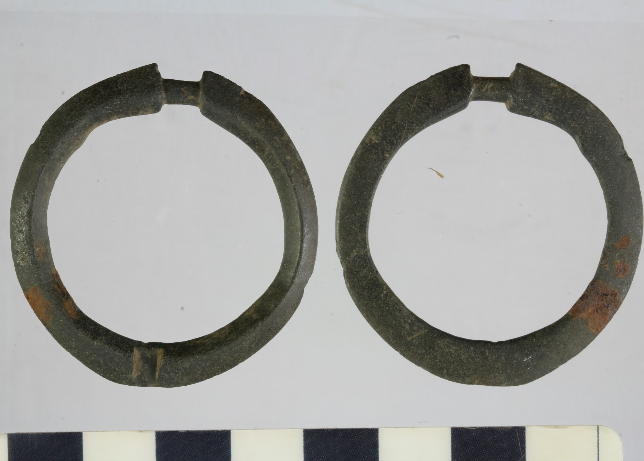
In the High Middle Ages, long before buttons became standard, wealthy nobles wore silver or gold brooches inlaid with jewels, while everyday folk relied on plain, copper-alloy examples like this one. The reference cited in the finds database record—Dress Accessories c. 1150–c. 1450 from the Museum of London —shows that undecorated, bevelled brooches of this exact size were the absolute workhorses of medieval clothing. Used by men and women alike, these simple circular frames held tunics, cloaks, and chemises together at the neck or shoulder.
To wear one, a person gathered a lump of cloth up through the center of the ring, pushed the pin point through the fabric, and pulled the ring back down so the pin rested flat against the frame, keeping the garment secured under tension without tearing it.
Though missing its original pin—which would have been a thin copper-alloy wire that snapped, or an iron pin that rusted away in the soil—my brooch still sports that distinct, smooth grey-green surface patina that speaks of over seven centuries in the ground. The outer edge is subtly bevelled, angling down to a flat inner surface. On one side, the frame narrows into a 5.9mm pin constriction where the pin hinge once rested. Directly across from it lies a small, rectangular groove—the pin rest designed to catch the tip under tension.
Losing a brooch in a 13th- or 14th-century field meant a loose tunic or a mantle coming undone on a cold Wiltshire morning. Holding it now, I’m glad I trusted my gut—what looked like a scrap harness ring turned out to be a genuine piece of medieval everyday life, its story preserved in the soil for over 650 years.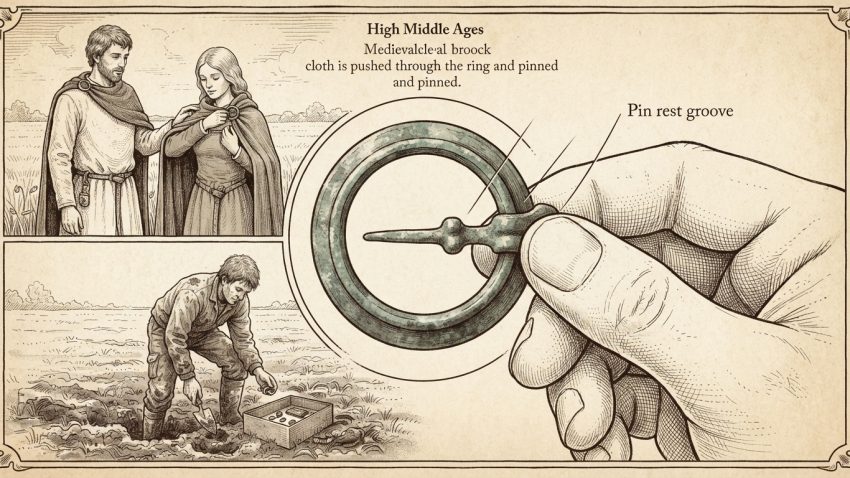
You must be logged in to post a comment.