
In a previous entry, I mentioned how easy it is to mistake small metal hooks for horse harness fittings. But this next recovery leaves no room for guesswork: a medieval enamel-inlaid harness pendant, logged under PAS reference WILT-042E25. Measuring 40mm long and weighing under ten grams, this ornate copper-alloy piece dates from between AD 1200 and 1400, spanning the high Middle Ages.
I remember finding this little item as if it were yesterday. It was the first thing I’d dug that matched the romanticised image I’d always held of the medieval period. As I turned it over in my gloved hand, boyhood images of King Arthur and questing knights came racing through my mind.
Harness pendants were decorative heraldic ornaments suspended from a horse’s breastplate, martingale, or bridle. As the horse trotted along, these small tags swung and flashed in the sunlight, advertising the status, allegiance, or noble lineage of the rider.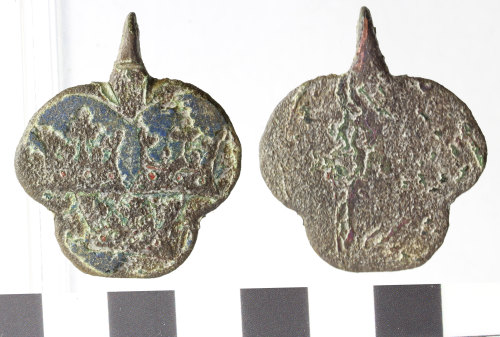
Despite spending hundreds of years buried in local soil, this pendant is complete and retains fascinating details. Shaped in a decorative trefoil—a three-lobed form—it features a transverse mounting loop projecting from the top. Its surface is inlaid with vibrant enamel depicting three golden crowns set against a bright blue field. On closer inspection, each crown’s band is set with three tiny red enamel pellets representing embedded jewels.
In the language of heraldry, “three crowns on a blue field” (azure, three crowns or) is a deeply iconic coat of arms. While similar pendants with red backgrounds were associated with the Bishop of Ely, the blue field on this piece points toward the famous Abbey of Bury St Edmunds—dedicated to Saint Edmund, the martyred 9th-century King of East Anglia.
Whether belonging to an official envoy, a wealthy pilgrim, or a knightly traveller, it is easy to picture an ecclesiastical entourage riding the road between Winchester, Clarendon Palace, and Salisbury—perhaps stopping in West Grimstead to witness the blessing of its newly expanded 13th-century church around the time its first recorded rector, Ricardus Brione, took his post in 1294. As the rider’s horse trotted along the track, its harness jingling with heraldic brass, the suspension loop snapped, dropping this vibrant piece of medieval pageantry into the village mud right along the path to St John’s.
This small harness decoration is one of my top 5 finds, —a vibrant, colourful link directly to the high medieval church and the nobility who once passed through the Dun Valley.
You must be logged in to post a comment.