
Today’s hunt took me quite a distance from my usual haunts around West Grimstead. I found myself in a series of smaller fields that slowly climbed up from the Dun Valley. The fields were interconnected by open gates and they currently tenanted by a dozen or so rather disinterested cattle.The field itself had probably never seen a plough and felt more like a holding pen than a place big enough for grazing.
I usually keep one eye on the herd as I detect, not because I’ve ever had any trouble, but because they expect food from humans and will often follow you everywhere, making it difficult to dig. I’ve even had them shadow me on the opposite side of a fence or gather at the gate expecting to be let into another field. A few of them will complain loudly when I ignore them.
My usual challenge of avoiding the herd was easily solved today; the steep incline seemed to be my ally. I suspect the cows were too content and comfortable at the bottom of the slope to bother walking up to where I was exploring. The steep, uncultivated incline was a good for another reason. I often find broken plough tips and tools in worked fields, and being large, dense bits of iron, my detector screams when I pass over them. The target is usually several inches long, giving a dull, scratchy, rumbling tone mixed with high points instead of a single, focused ‘hot point.’ And out of character for the terrain, this is precisely what happened just a few strides in; the high-pitched tone was spread over half a meter, and I rolled my eyes, not wanting to spend a lot of time digging thru the flinty soil to remove a heavy piece of scrap iron. Maybe it was a section of a rusty fence post, I thought, moving to step away.
But a step further and my detector continued to go off, loudly complaining like the aforementioned cows, telling me to pay attention. I turned back and scanned the spot from different angles and I realised the signal wasn’t one continuous mass, but separate targets, strewn along several feet. This shift in understanding changed the nature of the target instantly.
I knelt down and using only my dig tool, I carefully cut through the turf and flipped it over. It only took a second’s pinpointing to realise what I had found: a scattering of musket balls, or lead shot.
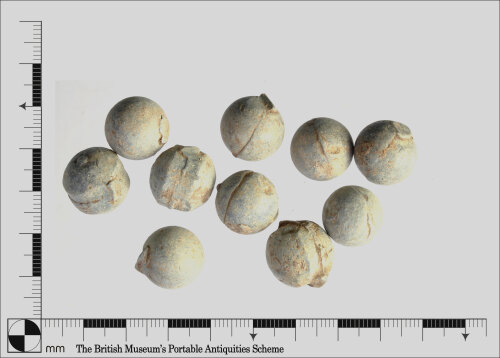
They weren’t deep in the soil, which was a surprise and a relief. I could run my pin-pointer across the ground around me and hear several more targets, all clustered together. After a few focused minutes of careful extraction, I found ten musket balls—marble sized, dull grey lead spheres—all within my arms reach.
A quick scan of the surrounding pasture revealed at least a dozen more targets all giving the same tone and the same VDI number. Finding this many in one place set off my imagination. As far as I knew, there hadn’t been any recorded conflicts or camps in this specific area, but I’m certainly no expert. However, I did know where to find one. Having decided to leave the rest of the targets untouched, I dug out my phone, my flask, and a mini pork pie to gnosh while I checked in with the museum.
Our Finds Liaison Officer (FLO) dampened my excitement a tad, noting that lead shot is a common find, but she agreed that finding this many in such a tight cluster was indeed interesting. The location was duly recorded, and we decided to leave the rest of the targets to their sleep for the moment, in case the cluster proved significant enough for further study. I was happy to do so, this tiny point in the finds database could point to a larger historical mystery someday, that’s what the database was for.
Analysis of the ten I brought in revealed their specific history: (WILT-494F8A)
They were from the Post-Medieval period, dating to circa AD 1600–1800 and most likely for a small arms Carbine (20–24 bore). Was this the precious load of a civilian hunter, or the prepared ammunition of a military trooper? This bore size was used by both. All showed evidence of being fired (banding, gouging, powder pitting) and all bore casting flashes; the little ridges or seams left between the two halves of the original mold. They were remarkably consistent, most weighing between 18–19 grams and measuring between 14 and 15 mm in diameter.
Lead shot may be a common find around here, perhaps even mundane to the academic eye, but they still managed to inspire a deep sense of mystery in me as any scattered coin hoard or decorated buckle. For the rest of the afternoon, and long after, I found myself imagining the different scenarios that led to their presence here: Were they hoarded for quick retrieval in a military cache? Or was some hunter or trooper thrown from his horse, his bag of precious ammunition scattered in the thick grass. The lead balls, inert and dense, would remain while the leather, the thread, the strap—rotted away long ago, leaving only a heavy cluster of shot to mark the site of the loss. Another clue lies in the cluster itself. This was a sudden loss of supply, not a single errant shot. You see, even the most ‘common’ of finds can unlock a powerful sense of wonder and connection to the lives lived hundreds of years ago beneath our feet.
You must be logged in to post a comment.