The Salisbury plains awoke this morning under a sky of shifting greys, promising a day of fitful showers that never quite delivered, leaving the air damp and mild. The distant rolling hills, normally a vibrant and varied green, were instead a more uniform green under a soft, diffused light, giving the landscape a contemplative air.
There’s a particular gate I favour, marking the boundary of a familiar field – a sprawling, ancient pasture to the south of Salisbury that often yields secrets. It’s the same gate, in fact, where my car found rather too much purchase after a recent downpour, leaving my vehicle stubbornly mired in the rich, clinging mud of Wiltshire. Today, though, the ground beneath my feet felt firmer, a blessing I didn’t take for granted. This gate, incidentally, seems to be a magnet for lost treasure; last summer, I pulled a beautiful Georgian florin right out of the hardened mud where cattle and horses have churned the earth for at least two centuries. That find was a true testament to the layers of history beneath our feet.
As I stepped from the car, my eyes had already begun their restless scan of the ground. It’s a habit, a subconscious dance with the earth, and sometimes, just sometimes, the earth chooses to reveal a glint without the need for a shovel. Today was one such day. There, exposed to the sun on the flinty path leading to the gate, a small disc caught the light. No signal, no digging, just a simple, surface find, yet it immediately fired my imagination far more than many a deeper signal.
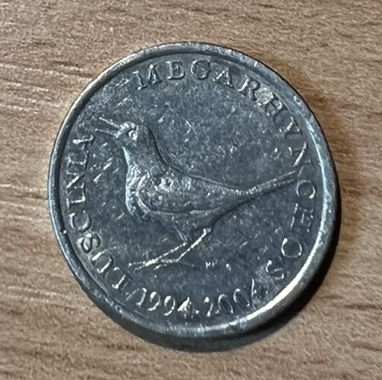
It was a coin, distinct and foreign. Not bearing the usual Queen’s head or forgotten farthing, but something altogether more exotic: a Croatian Kuna, specifically from 2004, celebrating Croatia’s switch to the Euro. It’s obverse featured a striking commemorative design – a sweet nightingale in profile. Given that the Kuna is no longer legal tender, and the considerable distance between Salisbury and the sun-drenched Adriatic coast, its presence here is truly a captivating mystery. I admit to having to google the text on the coin, as I had no idea what language it was in. The coin says REPUBLIKA HRVATSKA and that led to a great page about the coin on the Numista website.
How did it come to rest by this humble gate, on the edge of a foot path connecting ancient villages? My mind immediately conjured images of an unlucky hiker, perhaps a backpacker tracing the ancient flint trails that criss-cross this region, his pockets jingling with various currencies before a momentary slip saw this memento of a Mediterranean journey fall unseen. Or perhaps it was a local resident, returned from a Croatian holiday, the coin slipping from a hole in the bottom of a rucksack, dislodged and dropped unawares.
This field, you see, sits tantalisingly close to the poignant ancient ruins of Clarendon Palace, a site that has witnessed centuries of royal intrigue and historical events, drawing visitors from far and wide for generations. Indeed, a well-known circular hiking route (a pleasant 4.8-mile walk) connects the ruins of the palace to the charming village of Pitton, where one can find the truly excellent Silver Plough pub – a perfect spot for weary walkers to reflect on their journey and perhaps share a pint.
For me, metal detecting is less about the inherent value of the metal, and more about the profound value of the stories each object holds. This little Kuna, far from home and no longer holding monetary value, resonates with the silent passage of time and the endless human narratives imprinted on the landscape. The thought of it traveling over 800 miles and then lying silently for a day, a year, or a decade or two, a whisper from another country, offers a unique kind of meditative satisfaction. Each find, no matter how small or how surface-level, carries with it an echo of someone else’s journey, waiting to be wondered about, and if possible, retold.



You must be logged in to post a comment.