
A clear, bright day with a nip in the air, the kind of weather that makes you want to stride out across the Wiltshire plains just to keep warm. I was detecting a piece of ground in East Grimstead, not far from the quiet meander of the River Dun—a landscape as quiet and contemplative as the distant Holy Trinity Church I could just make out around the river’s bend. I found it perfect for pondering the deeper layers of local history.
The signal was strong and solid—a good lump of metal—and what emerged was a semi-circular piece of lead alloy several centimetres thick. No wonder it rang out so strongly in my headphones. It was smooth, whitish grey, and decidedly enigmatic at first glance.
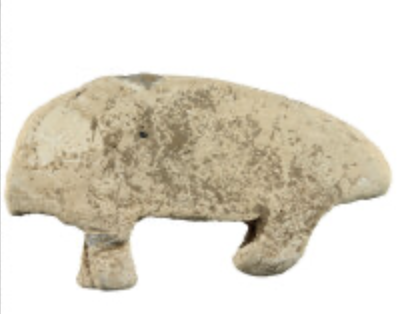
I was immediately taken with it, imagining it to be a small, charming find. Freed from the dirt I turned it over and over in my hands imagining that it must be a little pig figurine, perhaps a hand-cast toy for a child in the village. The white patina of the old lead gave it a definite air of antiquity. I thought about how lead was used as ubiquitously in the past as aluminium is today.
My curiosity was piqued, and my enthusiasm was matched by the Finds Liaison Officer. She studied its crudely cast shape and, looking at the same details, speculated that it was a bear, suggesting its age was much older than I thought. Perhaps a personal charm or amulet? For a wonderful moment, the object had a mystical history—a little, hand-carved talisman lost on the riverbank.
But this find provides a perfect lesson in the importance of expert analysis. What began as a fanciful pig, then became an enigmatic bear, was, in the end, a lead back-weight from a hickory wooden golf club, likely dating anywhere from 1850 to 1970. The specific shape—flat, semi-circular with small protrusions—is characteristic of weights inserted into the head of a golf club to perfect its balance and swing.

Rights Holder: Salisbury and South Wiltshire Museum used under CC License
This object might have sat in my collection forever mislabeled if I hadn’t turned it over to the experts at the museum. The truth turned out to be far more interesting than a child’s toy, offering a slice of sporting and local history I would never have imagined on my own. It is a profound piece of humility for any detectorist, confirming that the ground always has a story to tell, but we sometimes need a little expert guidance to read it correctly. Every find tells a story.
Key Details:
• Unique ID: WILT-4DB178
• Object Type: Post-Medieval to Modern Lead Alloy Golf Club Weight
• Historical Context: Likely a back-weight used to balance the head of a hickory-shafted wooden golf club (c. 1850-1970). The object’s true identity was only confirmed after specialist analysis, following initial misidentification as a lead animal figure. Found in East Grimstead near the River Dun.
• Dimensions: Length: 46.6 mm; Weight: 58.97 g